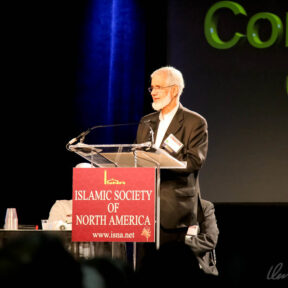
Muzammil Siddiqi
: Photo from Creative Commons / Author of Photo: umar nasirOverview
* Former board president of the Islamic Society of North America
* Has served as an official with numerous Islamist organizations
* Has praised Muslim suicide bombers and jihad
Born in India in 1943, Muzammil Siddiqi received a graduate degree in Arabic and Islamic studies from the Islamic University of Medina in Saudi Arabia. He then earned an M.A. in theology from Birmingham University in England, and a Ph.D. in comparative religion from Harvard University. From 1976-80, Siddiqi chaired the Department of Religious Affairs at the Muslim World League Office to the United Nations. He also has served, at various times, as chairman of the Muslim Students Association‘s Religious Affairs Committee; as a member of the Supreme Council of Mosques in Makkah, Saudia Arabia; and as a member of the Supreme Islamic Council of Egypt. From 1997-2000 Siddiqi was president of the Islamic Society of North America (ISNA), on whose board of directors he continues to sit. He is also a founding member of the Council of Mosques in the U.S. and Canada; a spokesman for the Fiqh Council of North America; director of the Islamic Society of Orange County (ISOC), a California-based mosque; and chairman of the ISNA-affiliated North American Islamic Trust.
In 1992, Siddiqi’s ISOC hosted a lecture by Sheikh Omar Abdel Rahman, longtime spiritual leader of Egypt’s militant Islamic Group. In that lecture, Rahman emphasized that jihad was, by definition, a violent undertaking that all Muslims were obliged to wage against the enemies of their faith. Siddiqi subsequently translated Rahman’s remarks, in order to make them accessible to a wider audience. Also in his capacity at ISOC, Siddiqi played a major role in the 1995 conversion (to Islam) of Adam Gadahn, a young American who, after being radicalized at the mosque, fled to the Middle East and ultimately emerged as a spokesman for al Qaeda (under the name “Azzam the American”).
In a 1995 speech, Siddiqi praised Islamic suicide bombers as “those who die on the part of justice” and who, consequently, reside “with the Lord” in a place of “the highest honor.”
In a mid-1990s lecture in California, Siddiqi predicted “the victory of Islam in Palestine” by means of jihad, which he defined as “the path” and “the way [for Muslims] to receive the honor.”
In October 1996, Siddiqi wrote an article encouraging Muslim residents of non-Islamic nations to become politically active as a means of persuading their respective societies to adopt elements of sharia law: “By participating in a non-Islamic system, one cannot rule by that [sharia] which Allah has commanded,” said Siddiqi. “But things do not change overnight. Changes come through patience, wisdom and hard work. I believe that as Muslims we should participate in the system to safeguard our interest and try to bring gradual change for the right cause …” “Once more people accept Islam,” Siddiqi stated on a later occasion, “the implementation of sharia in all areas” would be sure to follow.
At an October 2000 “Jerusalem Day Rally” in Washington, DC, Siddiqi demanded that the U.S. government “stop feeding the Israeli war machinery.” Declaring that “Jerusalem belongs to Islam,” he warned that if America chose to “remain on the side of [Israeli] injustice, the wrath of God will come.”
In June 2001 Siddiqi cited “the Koran” and “the sayings of the prophet Mohammed” as unimpeachable sources justifying his conviction that “Islam is totally against homosexuality.” While claiming not to condone violence against gay people, Siddiqi expressed support for laws making homosexuality punishable by death in certain countries.
Notwithstanding his pro-jihad, pro-sharia views, Siddiqi strove to portray himself as a moderate to Western, English-speaking audiences. He accomplished this, in large measure, by participating in “inter-faith initiatives” that seemed to convey respect for other religious traditions. Consequently, three days after the 9/11 attacks, President George W. Bush called on Siddiqi to read a prayer during the National Day of Prayer and Remembrance services at Washington’s National Cathedral. Bush subsequently praised Siddiqi for having done “a heck of a good job” at the Cathedral, adding that “we were proud to have him there.” When Bush met with Muslim community leaders at the White House a few weeks later, Siddiqi was again among the president’s guests.
In a 2006 sermon, Siddiqi turned his attention to the Muslim riots that had recently erupted in response to a Danish newspaper’s publication of some political cartoons mocking the Prophet Muhammad. While Siddiqi did “not condone any violence,” he declared that “they [non-Muslims] should not insult us and humiliate us by abusing his [Muhammad’s] name, his personality and character in public.”
For additional information on Muzammil Siddiqi, click here.