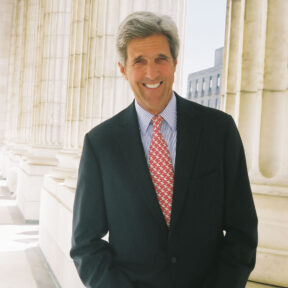
John Kerry
: Photo from Wikimedia Commons / Author of Photo: United States CongressOverview
* Longtime Democratic Senator from Massachusetts and 2004 Democratic Presidential nominee
* In the early 1970s, he denounced U.S. for alleged systematic “war crimes” in Vietnam.
* Organizer of Vietnam Veterans Against the War
* Worked to cut off aid to anti-Communist guerrillas in Nicaragua during the 1980s
* Proposed large reductions in U.S. defense and intelligence spending
* Succeeded Hillary Clinton as U.S. Secretary of State in 2013
Introduction
John Forbes Kerry was born December 11, 1943 in Denver, Colorado. His father, Richard Kerry (1915–2000), was a Foreign Service Officer and an attorney for the Bureau of United Nations Affairs. His mother, Rosemary Forbes Kerry (1913–2002), was a World War II nurse and a member of the wealthy Forbes family.
In 1966 John Kerry graduated from Yale University with a degree in political science and a cumulative, four-year average grade of 76. He registered four D’s in his freshman year, including a 61 in geology, a 63 and a 68 in two history courses, and a 69 in political science. He also received one D in his sophomore year.
After completing college, Kerry enlisted in the U.S. Navy. He served as a swift boat captain in Vietnam’s Mekong Delta and rose to the rank of lieutenant. For his combat duty, Kerry received a Silver Star, Bronze Star, and three Purple Hearts.
Kerry and the Anti-War Movement
After his discharge from the Navy in early 1970, Kerry became a prominent figure in the anti-America, pro-Hanoi crowd of antiwar protesters personified most visibly by Jane Fonda. Like so many of those activists, Kerry publicly maligned U.S. soldiers. He became a spokesman and organizer for the group Vietnam Veterans Against the War, and he developed close ties to Ramsey Clark, who had served as Attorney General under President Lyndon Johnson.
During an unsuccessful run for Congress in 1970, Kerry, depicting the United States as a country whose aggressive impuses needed to be reined in by outside forces, said: “I’m an internationalist. I’d like to see our troops dispersed through the world only at the directive of the United Nations.”
On May 23, 1970, Kerry married Julia Thorne, the sister of one of his former classmates at Yale. (The couple would go on to have two daughters together but were divorced on July 25, 1988, and the marriage was formally annulled in 1997.)
At the Paris Peace Talks in late May 1970, Kerry met with delegations representing both the Democratic Republic of Vietnam (DRV, the government of the North Vietnamese communists) and the Provisional Revolutionary Government (PVR, which was an arm of the DRV that included the Vietcong). Neither of these delegations included anyone representing the interests of the U.S., its allies, or the South Vietnamese. Kerry and the delegates discussed a variety of proposals for ending the war—especially the seven points enumerated by the top Vietnamese delegate, Madame Nguyen Thi Binh (a winner of the Lenin Peace Prize). Kerry, who met face-to-face with Binh as well, strongly advised the U.S. Senate to accept those points.
It should be noted that Kerry took part in the aforementioned meetings even as then-National Security Adviser Henry Kissinger was trying to negotiate formally with Binh and the Viet Cong on behalf of the Nixon administration. Researcher and author Jerry Corsi, an expert on the anti-war movement, said: “You don’t advocate that [seven-point] plan unless you are on the communist side. It was seen as surrender. [The U.S.] would have had to pay reparations and agree that we essentially lost the war…. Kerry was openly advocating that the communist position was correct and that we were wrong. He had become a spokesman for the communist party.”
At that time, Kerry himself acknowledged that his visits to Paris were “on the borderline of private individuals negotiating, et cetera.” This was significant because a federal law known as the Uniform Code of Military Justice prescribed severe punishment (including, in some cases, the death penalty) for any person who “without proper authority, knowingly harbors or protects or gives intelligence to or communicates or corresponds with or holds any intercourse with the enemy, either directly or indirectly.” Jerry Corsi affirmed that Kerry violated U.S. code 18 U.S.C. 953, which states: “A U.S. citizen cannot go abroad and negotiate with a foreign power.”
During the months that followed the Paris Peace Talks, Kerry became increasingly strident in his insistence that the U.S. accept Madame Binh’s (i.e., the Viet Cong’s) peace proposals. VVAW went so far as to sign a “People’s Peace Treaty” (reportedly drafted in Communist East Germany in December 1970), whose nine points were all extracted from a list of Viet Cong conditions for ending the war. Kerry fully supported this treaty. According to Gerald Nicosia, a historian of the antiwar movement: “These [VVAW] people signed their own symbolic ‘people’s peace treaty’ with the Vietnamese. As [VVAW co-founder] Jan Barry recalls, the gesture was intended as a means of embracing the people they had harmed, of asking forgiveness for those they had killed.”
In early September 1970, Kerry was a featured speaker at the VVAW-sponsored Operation RAW (Rapid American Withdrawal), an antiwar march that began in Morristown, New Jersey and ended in Valley Forge, Pennsylvania. Fellow speakers included such notables as Jane Fonda and Michael Lerner. He and Jane Fonda were photographed sitting near each other at the event.
By frequently participating in VVAW demonstrations, Kerry marched alongside many revolutionary Communists. Exploiting his presence at such rallies, the Communist publication Daily World prominently published photographs of Kerry addressing anti-war protestors, some of whom were carrying banners with portraits of Communist Party leader Angela Davis. Openly organized by known Communists, these rallies were typified by what the December 12, 1971 edition of the Herald Traveler called an “abundance of Vietcong flags, clenched fists raised in the air, and placards plainly bearing legends in support of China, Cuba, the USSR, North Korea and the Hanoi government.”
From January 31 to February 2, 1971, Kerry participated in the so-called “Winter Soldier Investigation” in Detroit, where more than 100 Vietnam veterans and 16 civilians testified that U.S. troops had routinely, and as a matter of policy, committed atrocities—including rape, arson, torture, and mass murder—against innocent civilians in South Vietnam.
In April 1971 Kerry helped organize one of the most confrontational series of antiwar protests of the period—five days of rallies in which nearly 1,000 self-identified Vietnam veterans gathered on Washington, DC’s Mall for what they termed “a limited incursion into the country of Congress.”
On April 22, 1971, Kerry testified before the Senate Committee on Foreign Relations and stated that at the Winter Soldier Investigation, many Vietnam veterans had “told stories that at times they had personally raped, cut off ears, cut off heads, taped wires from portable telephones to human genitals and turned up the power, cut off limbs, blown up bodies, randomly shot at civilians, razed villages in fashion reminiscent of Genghis Khan, shot cattle and dogs for fun, poisoned food stocks, and generally ravaged the countryside of South Vietnam in addition to the normal ravage of war…” “We learned the meaning of free fire zones,” added Kerry. “Shooting anything that moves, and we watched while America placed a cheapness on the lives of Orientals.” Further, Kerry charged that America’s “war crimes committed in Southeast Asia” were “not isolated incidents but crimes committed on a day-to-day basis with the full awareness of officers at all levels of command.” He promoted the leftist worldview of a racist America that was no better than its Communist enemy: “We saw that many people in this country had a one-sided idea of who was kept free by our flag, as blacks provided the highest percentage of casualties.” And he declared, “We cannot fight Communism all over the world, and I think we should have learned that lesson by now.”[1]
More than three decades later, when Kerry was running for U.S. President, the publication U.S. Veteran Dispatch noted that Kerry’s 1971 Senate testimony had “occurred while some of his fellow Vietnam veterans were known by the world to be enduring terrible suffering as prisoners of war in North Vietnamese prisons.” Similarly, Senator John McCain recalled that his North Vietnamese captors had used reports of Kerry-led protests to taunt him and his fellow prisoners. Retired General George S. Patton III angrily charged that Kerry’s actions had given “aid and comfort to the enemy.” And the organization Vietnam Veterans Against John Kerry stated:
“As a national leader of VVAW, Kerry campaigned against the effort of the United States to contain the spread of Communism. He used the blood of servicemen still in the field for his own political advancement by claiming that their blood was being shed unnecessarily or in vain…. Under Kerry’s leadership, VVAW members mocked the uniform of United States soldiers by wearing tattered fatigues marked with pro-communist graffiti. They dishonored America by marching in demonstrations under the flag of the Viet Cong enemy.”
It should be noted that the chairman of the Senate hearing at which Kerry spoke was Foreign Relations Committee chair J. William Fulbright (D-Arkansas), who, according to the New York Sun, “stood for three things in his time: [c]apitulation to the communists in Vietnam, segregation of the races, and … hostility to the Jewish state.” In other words, says the Sun:
“Mr. Kerry was ushered onto the national stage by a senator who really did have a messianic and obsessive hostility to Israel…. In the same year that Fulbright invited Kerry to libel our GIs, the Dixiecrat made a speech at Yale in which he warned that, as the Associated Press put it, the United States ‘could be drawn into war with the Soviet Union by Israeli Communist-baiting humbuggery.’ He insisted that America was permitting ‘client states like Israel and South Vietnam to manipulate American policy toward purposes contrary to our interests.’ … Golda Meir, incidentally, was onto Fulbright’s game. ‘Can you remember when Senator Fulbright has said anything positive about Israel?’ Israel’s fourth prime minister once asked an interviewer. That was after the Arkansan went on CBS’s Face the Nation to complain that the Senate was ‘subservient’ to the Jewish state.”
On April 23, 1971—the day after his Senate testimony—Kerry and a number of fellow antiwar veterans ceremoniously threw away some of the medals and ribbons with which they had been honored for their service. On April 24, Kerry explained his actions: “In a real sense, this [Nixon] Administration forced us to return our medals because beyond the perversion of the war, these leaders themselves denied us the integrity those symbols supposedly gave our lives.” Several months later—in a November 6, 1971 interview on the WRC-TV program Viewpoints—Kerry confirmed that: “I gave back, I can’t remember, six, seven, eight, nine medals.” These included the Bronze Star, Silver Star and three Purple Hearts.
In subsequent years, Kerry would offer differing versions of what had happened to his military medals:
- During his first run for the U.S. Senate in 1984, he reported that he was still in possession of his medals, and that the only medals he had thrown away actually belonged to another soldier.
- In 1988 he said he had thrown away three ribbons which he had been awarded for combat wounds, but not his medals. “I was proud of my personal service and remain so,” Kerry told the National Journal.
- In 1996 he told the Boston Globe that he had indeed thrown out his ribbons but not his medals. The latter had been spared, Kerry said, not because he valued them but because he “didn’t have time to go home [to New York] and get them.”
- During his 2004 presidential run, he repeatedly denied having discarded any of his medals. In a December 2003 interview, for example, Kerry said: “I’m proud of my medals. I always was proud of them,” adding that he had only gotten rid of his “ribbons.” In April 2004 he told a Los Angeles Times reporter: “I threw my ribbons. I didn’t have my medals. It is very simple…. We threw away the symbols of what our country gave us for what we had gone through.”
In the summer of 1971, Kerry traveled to Paris to discuss with North Vietnamese and Viet Cong delegations the conditions under which they might agree to release U.S. prisoners of war. This particular act of private diplomacy was likely a violation of the so-called Logan Act, which states:
“Any citizen of the United States, wherever he may be, who, without authority of the United States, directly or indirectly commences or carries on any correspondence or intercourse with any foreign government or any officer or agent thereof, with intent to influence the measures or conduct of any foreign government or of any officer or agent thereof, in relation to any disputes or controversies with the United States, or to defeat the measures of the United States, shall be fined under this title or imprisoned not more than three years, or both.”
In a 1971 interview with William F. Buckley, Kerry delivered this broadside against American arrogance and “moralism”:
“I don’t think that the United States, and I think this is the biggest problem about Vietnam, can necessarily apply moral, moralisms to its commitments around the world. And I think this is one of the great fallacies of our foreign policy at the present moment. Interventionism as well as globalism both stem from the same kind of moralism. And in a certain sense I think that moralism can be very defeating for the United States in its undertakings. It gets us into a sort of messianic enterprise, whereby we have this impression that somehow we can go out and touch these other countries and change them. And I think this is what in a sense led us into Vietnam — an extension of what we did to react to the Soviet Union in Europe, what we have done to react to this threat of Communism around the world. And we have this moralism which has been applied to all of our efforts since the founding of the United States, which is now interspersed in every single policy and effort that we make, and I think that as a result it’s coming back to haunt us. Because it haunts us at home, in so much as there are many areas that we have very really been unable to apply that moralism here, where equality of opportunity and many other things are concerned, as well as abroad, where we have found, especially in Vietnam, that we have not been able to apply these changes quite as quickly or as sweepingly as we thought.”
In November 1971 Kerry attended a series of VVAW meetings in Kansas City, Missouri, at which a plan to assassinate U.S. Senators, known as the “Phoenix Project,” was debated and ultimately voted down. Historian Gerald Nicosia says, “My evidence is incontrovertible. He [Kerry] was there.” Nicosia adds that Kerry then resigned from VVAW on the third day of the meetings because of the extreme actions the group was considering.**
Rise of a Political Career
In September 1973 Kerry enrolled at Boston College Law School, where he went on to earn a J.D. three years later. After graduating, he found work as a prosecutor in the office of the District Attorney of Middlesex County, Massachusetts. In 1982 he was elected lieutenant governor of the state.
When Paul Tsongas, the junior U. S. Senator from Massachusetts, announced in 1984 that he would be stepping down for health reasons, Kerry, a Democrat, decided to run for Tsongas’ seat. He emerged victorious and was subsequently re-elected in 1990, 1996, 2002, and 2008.
Condemning the Reagan Administration’s Actions in Grenada
Kerry denounced the 1983 U.S. invasion of Grenada—a measure that overthrew the island nation’s communist government and replaced it with a pro-Western one. Likening the conflict to “Boston College playing football against the Sisters of Mercy,” he said: “The invasion of Grenada represents the Reagan policy of substituting public relations for diplomatic relations … The invasion represented a bully’s show of force against a weak Third World nation. The invasion only served to heighten world tensions and further strain brittle U.S.–Soviet and North–South relations.”
Opposing the Strategic Defense Initiative (Missile Defense)
Shortly after President Reagan’s first proposed the creation of a missile-defense system (known as the Strategic Defense Initiative, or SDI) in 1983, Kerry denounced the idea as dangerous and unrealistic. In June 1985, for instance, the senator called for deep cuts in funding for the program, disparaging it as a nothing more than a “Star Wars”-type fantasy. Said Kerry:
- “We must also recognize that we could never test a Star Wars system under realistic conditions until the moment of an all-out nuclear attack.”
- “If Star Wars didn’t work perfectly the very first time [the result] would be the destruction of our society.”
- “This is the time we must say ‘no’ to the president’s dream, a dream based on illusion, but one which could have real and terrible consequences.”
In August 1986, Kerry said that “what we must do is deny this program the funds that would enable this cancer on our nation’s defense to grow any further.”
Kerry and Central America
On April 18, 1985, Kerry and fellow Democratic Senator Tom Harkin—in a trip arranged by the Institute for Policy Studies—traveled to Nicaragua to meet with that country’s president, Daniel Ortega, whose communist Sandinista government had strong ties to the Soviet Union and Cuba. (The Sandinistas had ethnically cleansed the Miskito Afro-Indians and destroyed Nicaragua’s Jewish community.) At that time, the Reagan Administration was backing a rebel Nicaraguan force known as the Contras. Kerry justified his action by saying, “Senator Harkin and I are going to Nicaragua as Vietnam-era veterans who are alarmed that the Reagan administration is repeating the mistakes we made in Vietnam. Our foreign policy should represent the democratic values that have made our country great, not subvert those values by funding terrorism to overthrow governments of other countries.” Added Kerry: “I am willing … to take the risk in the effort to put to test the good faith of the Sandinistas.”
As his plane landed in Nicaragua, Kerry said: “Look at it. It reminds me so much of Vietnam. The same lushness, the tree lines…. If you look back at the Gulf of Tonkin resolution, if you look back at the troops that were in Cambodia, the history of the body count and the misinterpretation of Vietnam itself, and look at how we are interpreting the struggle in Central America and examine the CIA involvement, the mining of the harbors, the effort to fund the Contras, there is a direct and unavoidable parallel between these two periods of our history…. I see an enormous haughtiness in the United States trying to tell them [the Nicaraguans] what to do…. These [Nicaraguans] are just poor people, no money, no food, just like Vietnam, and they are just trying to stay alive. They just want peace. They don’t want their daughter getting blown away on the way to teach! Or their sons disappearing. It’s just terrible. I see the same sense of great victimization. The little kids staring wide-eyed and scared. It really hits home the same way as Vietnam…. If we haven’t learned something by now about talking rather than fighting …”
Through Kerry and Harkin, President Ortega offered a cease-fire agreement on the condition that the U.S. stop aiding the Contras. Kerry described this as “a wonderful opening” toward peace. But President Reagan denounced the offer as a transparent “propaganda initiative” designed to influence an upcoming House vote on a $14 million Contra aid package. The State Department emphasized that the Sandinistas should talk to the Contras themselves, not to the United States: “Without such a dialogue, a cease-fire is meaningless — essentially a call for the opposition to surrender. The opposition is asked to accept Sandinista consolidation of a Marxist-Leninist order in Nicaragua.” Secretary of State George Shultz decried Kerry as one of a number of “self-appointed emissaries to the Communist regime” in Managua, and said, “We cannot conduct a successful policy when [such people] take trips or write ‘Dear Comandante’ letters with the aim of negotiating.” Former Secretary of State Henry Kissinger, for his part, declared: “If the Nicaraguans want to make an offer, they ought to make it through diplomatic channels. We can’t be negotiating with our own congressmen and Nicaragua simultaneously.”
Kerry, meanwhile, made the case for his side by going to the Senate floor and issuing the following impassioned remarks: “It is not just the fact that American youth may be called on once again to fight and to die in the jungles and mountains of another Third World country. It is not just that that weighs on my conscience today…. It is the fact that the grinding poverty in that area [Nicaragua] is so real and apparent, the legacy of a brutal dictatorship installed by American force some 50 years ago and which in concert with a tiny economic elite plundered the natural resources of the countryside while more than 80 percent of the population were forced to eke out a meager subsistence for themselves and their families…. If there is one guarantee of increasing the Soviet presence in Nicaragua, it will be to force that government into no other choice but that of turning to the Soviet Union…. [T]his administration seems to protect American interests by wanting to continue the process of escalating killing…. Here, Mr. President, in writing, is a guarantee of the security interest of the United States [a reference to a non-binding aide-memoire given to him by Ortega]…. My generation, and a lot of us, grew up with the phrase ‘Give peace a chance,’ as part of a song that captured a lot of people’s imagination. I hope that the president of the United States will give peace a chance.”
The House of Representatives ultimately voted against the Contra aid, but Ortega nevertheless flew to Moscow (the day after the House vote) to accept a $200 million loan from the Soviets. Unfazed by this embarrassing turn of events, Kerry remained confident that his position had been the right one all along, telling one interviewer: “We negotiated with North Vietnam. Why can we not negotiate with a country smaller than North Carolina and with half the population of Massachusetts? It’s beyond me.”
In December 1985, Kerry was the only U.S. senator to vote against the appropriation of funds for police training in El Salvador, Honduras, Guatemala, and Costa Rica.
In 1986, Kerry supported a “fast for life” initiative by four U.S. military veterans protesting President Reagan’s “illegal and extraordinarily vicious wars against the poor of Nicaragua, El Salvador, and Guatemala.” Fellow supporters of the “fast for life” included Ted Kennedy, Leon Panetta, Tom Harkin, David Bonior, Lane Evans, and Patrick Leahy.
In the late 1980s, Kerry headed the Subcommittee on Terrorism, Narcotics, and International Operations. In that role, he tried to prove that the Nicaraguan Contras were drug-runners. Most notably, he tried (unsuccessfully) to link Vice President George W. Bush, who was running for the White House, to the Contras’ alleged criminality. One Republican aide at the time said the following:
“[Senator Ted] Kennedy’s people were liberal, to be sure, and so were [Senator Chris] Dodd’s. But Kerry’s people were much more rabid. They promoted the most bizarre conspiracy theories around…. There was a real fruity network of goofball and semi-subversive people, and Kerry ran with those people. He was always a bit aloof himself, but you can tell a lot about politicians by the people they let in. These weren’t liberals. They had a shockingly hostile attitude toward the United States—our military, our intelligence community, our policies.”
As journalist Jay Nordlinger writes regarding Kerry’s drug-running allegations: “The Kerry Committee never accomplished its objective, but it attracted a lot of media attention and damaged individual reputations. On this committee, all the hopes, energies, and notions of IPS, the Christic Institute, CISPES, and the rest of that now-forgotten crowd came together.”
When Violeta Chamorro (who was backed by the Bush administration) was elected president of Nicaragua in February 1990 (unseating the Communist Daniel Ortega), an interviewer asked Kerry: “Does this mean the United States did the right thing all those years by funding the Contras?” The senator replied, “Well, I think that’s almost an irrelevant debate right now. I don’t happen to believe that, because many of us believe it could have been a different form of pressure. But the important thing now is that the election has taken place. I really think it’s more of a triumph of multi-nation diplomacy.”
Kerry & the Institute of Policy Studies
In the 1980s, Senator Kerry hired Gareth Porter, a former fellow of the Institute for Policy Studies, as a legislative aide.**
Kerry’s Controversial Joke about Dan Quayle
At a November 15, 1988 businessmen’s breakfast in East Lynn, Massachusetts, Kerry made a joke about then-president-elect George H.W. Bush and his vice president, saying: “If Bush is shot, the Secret Service has orders to shoot Dan Quayle.” Kerry apologized the following day for the remark.
Kerry and POWs in Vietnam
As chairman of the Select Senate Committee on POW/MIA (Prisoners Of War/Missing In Action) Affairs—which was created in 1991 to determine whether any American POWs or MIAs were still alive in Vietnam—Kerry, who favored a normalization of U.S. relations with that country, pressured the panel to conclude that no American servicemen remained there. According to the U.S. Veteran Dispatch, “[N]o one in the United States Senate pushed harder to bury the POW / MIA issue, the last obstacle preventing normalization of relations with Hanoi, than John Forbes Kerry.” Controversy erupted in December 1992, however, when the U.S. Veteran Dispatch issued a report whose substance raised questions as to what may have motivated Kerry to so avidly pursue normalization:
“Vietnam announced it had granted Colliers International, based in Boston, Massachusetts, a contract worth billions designating Colliers International as the exclusive real estate agent representing Vietnam. That deal alone put Colliers in a position to make tens of millions of dollars on the rush to upgrade Vietnam’s ports, railroads, highways, government buildings, etc. C. Stewart Forbes, Chief Executive Officer of Colliers International, is Kerry’s cousin.”
Second Marriage
On May 26, 1995, Kerry married the philanthropist Teresa Heinz Kerry, whom he had met at an Earth Day rally five years earlier.
Kerry and the Democratic Socialists of America
In 2002, Kerry sent his greetings to a major gathering of the Democratic Socialists of America‘s (DSA) Boston chapter. When Kerry ran for U.S. President against George W. Bush in 2004, DSA urged its members to support Kerry (though its preferred candidates were Howard Dean and Dennis Kucinich).
Kerry the “Inernationalist”
In April 2004, newsman Tim Russert asked Kerry to clarify his 1970 assertion that U.S. foreign interventions should occur only at the behest of the United Nations. Kerry replied:
“That’s one of those stupid things that a 27-year-old kid says when you’re fresh back from Vietnam and angry about it. I have never, ever, ever, in any vote, in any policy, in any speech, in any public statement advocated any such thing in all of the years I’ve been in elected office. In fact, I say the following and I say it very clearly, I will never cede the security of the United States to any institution and I will never cede our security to any other country. No country will have a veto over what we need to do to protect ourselves.”
But in fact, Kerry’s 2003 book, A Call to Service, essentially echoed what he had said 33 years earlier. Wrote Kerry:
“In contrast to the dangerous mix of isolationism and unilateralism that characterizes the Republicans, [I support] speaking from a position of strength on international issues–the multilateral cooperative tradition of democratic internationalism forged in the course of two world wars and the cold war. It acknowledges that multilateral organizations are vehicles for the promotion of our ideals and interests around the world.”
Moreover, Kerry favors the establishment of an International Criminal Court operating under UN auspices.
Kerry Denounces “Benedict” Arnold CEOs” who Outsource Jobs
During his 2004 presidential run, Kerry denounced what he termed “Benedict Arnold CEOs” who were allegedly betraying America by “shipping jobs overseas” in order to avoid high U.S. corporate taxes and the high cost of doing business in the United States. When a Wall Street Journal reporter subsequently asked Kerry about his use of the “Benedict Arnold” epithet, the senator replied:
“The Benedict Arnold line applied, you know, I called a couple of times to overzealous speechwriters and said, ‘Look, that’s not what I’m saying.’ Benedict Arnold does not refer to somebody who in the normal course of business is going to go overseas and take jobs overseas. That happens. I support that. I understand that. I was referring to the people who take advantage of non-economic transactions purely for tax purposes — sham transactions — and give up American citizenship. That’s a Benedict Arnold. You give up your American citizenship but you want to continue to do business and deduct and do everything else. That’s what I’m referring to.”
But in fact, Kerry’s explanation was blatant revisionism. As the Washington Times pointed out, the senator had repeatedly — over a period of more than three months — attacked CEOs as “Benedict Arnolds” for relocating American jobs overseas. Said the Times:
“The first reference to ‘Benedict Arnold CEOs’ on Mr. Kerry’s Web site appeared in a speech prepared for his delivery on Nov. 15 [2003] at the Iowa Jefferson-Jackson Day Dinner. Mr. Kerry promised ‘a real deal that stands up to the powerful interests’ by ‘clos[ing] every loophole for the Benedict Arnold companies that ship jobs overseas.’ On Jan. 19 [2004], Mr. Kerry declared in his Iowa caucuses victory speech: ‘We are not going to give one benefit or one reward to any Benedict Arnold company or CEO who take the jobs and money overseas and stick you with the bill. That’s over.’
“Based on transcripts of speeches Mr. Kerry actually delivered (as opposed to ‘remarks prepared for delivery’ by his speechwriters), Mr. Kerry made virtually identical charges on Jan. 27, Feb. 3, Feb. 10 and Feb. 16, mostly following primary victories. Mr. Kerry leveled the charge in at least two Democratic debates in South Carolina in late January and at AFL-CIO headquarters in Washington on Feb. 19.
“In none of the speeches does Mr. Kerry talk about giving up citizenship, a crucial ingredient for becoming a Benedict Arnold CEO in the revision he offered to the Journal. Moreover, while he assured that newspaper that he [could] ‘understand’ and ‘support’ decisions by CEOs who, in ‘the normal course of business [are] going to go overseas and take jobs overseas,’ he never made such a distinction in his numerous victory speeches and debates. Quite the opposite.”
Islamist Donations
From 1998-2004, Kerry received a total of $4,750 in contributions from individuals affiliated with the Muslim American Society, the Islamic Society of North America, the Muslim Public Affairs Council, and the Council on American-Islamic Relations.
Losing the Presidental Election of 2004
Kerry and his running mate, Senator John Edwards, lost the 2004 presidential election by a margin of 286 electoral votes to 251.
Kerry & the Iraq War
In 2001, Kerry voted to authorize the use of military force against Saddam Hussein‘s Iraq. He took this position based on his firm conviction—which he publicly articulated on numerous occasions—that Saddam was seeking to develop weapons of mass destruction. During the weeks and months leading up to the March 2003 U.S. invasion, for example, Kerry made the following statements:
- “It would be naive to the point of great danger not to believe that, left to his own devices, Saddam Hussein will misjudge, provoke and stumble into a future, more dangerous confrontation with the civilized world. He has as much promised it.”
- “If Saddam Hussein is unwilling to bend to the international community’s already existing order, then he will have invited enforcement, even if the enforcement is mostly at the hands of the United States, a right we retain even if the Security Council fails to act.”
- “Without question we need to disarm Saddam Hussein. He is a brutal and murderous dictator, leading an oppressive regime. And we all know the litany of his offenses. The reason I think we need to really think about him is because he presents a particularly grievous threat through the consistency with which he is prone to miscalculation. He miscalculated an eight-year war with Iran. He miscalculated the invasion of Kuwait. He miscalculated America’s response to that act of naked aggression. He miscalculated the result of setting oil rigs on fire. He miscalculated the impact of sending scuds into Israel and trying to assassinate a former American President. He miscalculated his own military strength and he miscalculated the Arab world’s response to his misconduct. And now he is miscalculating America’s response to his continued deceit and his consistent grasp for weapons of mass destruction. That is why the world, through the United Nations Security Council, has spoken with one voice, demanding that Iraq disclose and destroy its weapons programs. So the threat of Saddam Hussein with weapons of mass destruction is real, but it’s not new. Since the end of the Persian Gulf War we’ve known this.”
- “Saddam Hussein could not be left to his own devices based on everything we learned about him for seven and a half years while we were inspecting in Iraq. People have forgotten that for seven and a half years, we found weapons of mass destruction. We were destroying weapons of mass destruction. We were, the United States of America, together with Ambassador Butler and the United Nations.”
But as the political winds shifted, Kerry and his fellow congressional Democrats began to portray, with ever-growing frequency, the Iraq War as a foreign-policy debacle that had been launched without justifiable cause. In 2004, for instance, Kerry charged that President Bush had not only “misled the American people” about the threat posed by Saddam, but had also “arbitrarily” decided that the “time for diplomacy is over” and “rushed our nation to war.” During a presidential debate that October, Kerry said: “Saddam Hussein didn’t attack us. Osama bin Laden attacked us. Al Qaeda attacked us.”
Kerry also accused the U.S. military of “terrorizing” the Iraqi people. On December 4, 2005, he told Bob Schieffer on Face the Nation: “And there is no reason, Bob, that young American soldiers need to be going into the homes of Iraqis in the dead of night, terrorizing kids and children, you know, women…”
Kerry again sparked controversy on October 30, 2006, when he spoke to an audience composed mostly of college students at a campaign rally for Democratic California gubernatorial candidate Phil Angelides. “You know,” said Kerry, “education, if you make the most of it, you study hard, you do your homework and you make an effort to be smart, you can do well. If you don’t, you get stuck in Iraq.” The following day, political leaders from both major parties criticized Kerry’s remarks as insulting to members of the U.S. military who were fighting in Iraq at that time. Kerry replied: “Let me make it crystal clear, as crystal clear as I know how. I apologize to no one for my criticism of the president and of his broken policy.” He then explained that his original remark was merely a “botched joke” that had been intended as a jab at President Bush. That is, he had inadvertently omitted from his comment the word “us,” which would have changed the offending sentence to: “If you don’t, you get us stuck in Iraq.”
Kerry Endorses Obama for President
On January 10, 2008, Kerry endorsed Illinois Senator Barack Obama for U.S. President.
Tax Controversy Regarding Kerry’s Yacht
In July 2010 the Boston Herald reported that Kerry had commissioned construction on a new $7 million-dollar yacht in New Zealand and subsequently moored it in Portsmouth, Rhode Island, where he could avoid paying Massachusetts taxes on the vessel (including some $437,500 in sales tax and an annual excise tax of approximately $70,000).
Kerry’s effort to avoid the aforementioned taxes on his yacht was inconsistent with his numerous prior denunciations (particularly during his 2004 presidential run) of “Benedict Arnold CEOs” who outsourced jobs overseas in order to minimize their taxes and business expenses. (See above: “KERRY DENOUNCES ‘BENEDICT ARNOLD CEOs’ WHO OUTSOURCE JOBS”)
Kerry and Global Warming / Climate Change
In the summer of 2012, Kerry delivered a speech on the Senate Floor warning of the dangers of “climate change,” which he said was “as dangerous as any of the sort of real crises that we talk about,” including the prospect of a nuclear-armed Iran, “because it affects life itself on the planet.” Kerry characterized those who doubted that human industrial activity causes global warming as “fundamentally a flat-earth caucus, a bunch of people … who still argue, against all the science, all the evidence,… that somehow we don’t know enough about climate change, or they argue that the evidence isn’t sufficient, or they argue that it just is a hoax.”
To limit the emission of greenhouse gases that allegedly cause global warming, Kerry supports the implementation of a “cap-and-trade” program. Toward that end, in September 2009 he and Senator Barbara Boxer together proposed the Clean Energy Jobs and American Power Act, which called for a cap-and-trade system as well as a 20% decrease on emissions by the year 2020.
On February 17, 2014, Kerry delivered, to an audience of students in Jakarta, Indonesia, a speech that was slated to be the first in an ongoing series of talks on the dangers of climate change. Aides said that Kerry had chosen Indonesia as the launch-point for the series because, as an archipelago of more than 17,000 islands, it was at great risk from the threat of rising sea levels. Said Kerry:
“Because of climate change, it’s no secret that today Indonesia is … one of the most vulnerable countries on Earth. It’s not an exaggeration to say that the entire way of life that you live and love is at risk….
“Think about the proliferation of weapons of mass destruction. It doesn’t keep us safe if the United States secures its nuclear arsenal while other countries fail to prevent theirs from falling into the hands of terrorists. The bottom line is this: it is the same thing with climate change. In a sense, climate change can now be considered another weapon of mass destruction, perhaps even the world’s most fearsome weapon of mass destruction.”
He added that climate change was every bit as significant as terrorism in terms of its monumental global implications:
“Terrorism, epidemics, poverty, the proliferation of weapons of mass destruction: all challenges that know no borders. The reality is that climate change ranks right up there with every single one of them.”
And he expressed impatience with skeptics who doubted that the pollutants associated with human industrial activity were responsible for climate change:
“We just don’t have time to let a few loud interest groups hijack the climate conversation. I’m talking about big companies that like it the way it is, that don’t want to change, and spend a lot of money to keep you and me and everybody from doing what we know we need to do. We should not allow a tiny minority of shoddy scientists … and extreme ideologues to compete with scientific fact. The science is unequivocal, and those who refuse to believe it are simply burying their heads in the sand.”
During a September 3, 2014 ceremony to appoint Texas lawyer Shaarik Zafar to be special representative to Muslim communities, Kerry said it was America’s biblical “duty” to confront climate change not only at home, but also abroad in “Muslim-majority” nations:
“Our faiths and our fates are inextricably linked … on any number of things that we must confront and deal with in policy concepts today. Our faiths are inextricably linked on the environment. For many of us, respect for God’s creation also translates into a duty to protect and sustain his first creation, Earth, the planet…. Confronting climate change is, in the long run, one of the greatest challenges that we face, and you can see this duty or responsibility laid out in Scriptures, clearly, beginning in Genesis. And Muslim-majority countries are among the most vulnerable. Our response to this challenge ought to be rooted in a sense of stewardship of Earth, and for me and for many of us here today, that responsibility comes from God.”
Speaking to the Atlantic Council at a climate-change forum on March 12, 2015, Kerry warned that if governments in the U.S. and elsewhere did not quickly take measures to avert manmade global warming, the result would be an “utter catastrophe” that would imperil “life as we know it on Earth.” Moreover, he likened the courage and determination of anti-climate-change advocates to that of Abraham Lincoln, Winston Churchill, Mahatma Gandhi, Nelson Mandela, and Martin Luther King Jr. Among Kerry’s remarks were the following:
- “For decades now, the science has been screaming at us, warning us, trying to compel us to act.”
- “[W]hen science tells us that our climate is changing and human beings are largely causing that change, by what right do people stand up and just say, well, I dispute that. Or I deny that elementary truth.”
- “Future generations will judge our effort, not just as a policy failure, but as a collective, moral failure of historic consequence. And they will want to know how world leaders could possibly have been so blind, or so ignorant, or so ideological, or so dysfunctional, and, frankly, so stubborn that we failed to act on knowledge that was confirmed by so many scientists in so many studies over such a long period of time and documented by so much evidence.”
- “[W]e need leaders with the political courage to make the tough but necessary policy choices that will help us all find the right path. And I am pleased to say and proud to serve with a president who has accepted that challenge, who has taken this head on.”
- “My heroes are people who dared to take on great challenges without knowing for certain what the outcome would be. Lincoln took risks, Gandhi took risks, Churchill took risks, Dr. King took risks, Mandela took risks. But that doesn’t mean that every risk-taker is a role model. It’s one thing to risk a career or a life on behalf of a principle or to save or liberate a population. It’s quite another to wager the well-being of generations and life itself simply to continue satisfying the appetites of the present or to insist on a course of inaction long after all the available evidence has pointed to the folly of that path.”
- “Gambling with the future of Earth itself when we know full-well what the outcome would be is beyond reckless; it is just plain immoral, and it is a risk that no one should take. And we need to face reality: There is no Planet B.”
Kerry and Syria
Since the early 2000s, Kerry has been the federal government’s highest-ranking apologist for Syrian President Bashar Assad. Indeed it was Kerry who made numerous efforts to undermine the Bush administration’s attempt to isolate the Syrian dictator after its courtship of him ended in failure in 2003; after Bush repeatedly accused Syria of supporting terrorists in Iraq and elsewhere; and after the United States withdrew its ambassador to Syria following the 2005 assassination of Lebanon’s former premier Rafiq Hariri in a car bombing most likely orchestrated by the Assad regime.
In February 2009, just days after Barack Obama’s inauguration, Kerry was sent to Syria as part of a policy review by an Obama administration that was looking to establish new relationships with countries the Bush administration had considered hostile. (This was the first of five trips Kerry would make to Syria between 2009 and 2011.)
During the February 2009 trip, Kerry listened to Bashar Assad advise him that Washington must “move away from a policy based on dictating decisions,” and that future relations between the U.S. and Syria should be based on a “proper understanding” by Washington of Middle East issues and interests. In return, Kerry used the occasion to bash the former administration. “Unlike the Bush administration that believed you could simply tell people what to do and walk away and wait for them to do it, we believe you have to engage in a discussion,” he said. Added Kerry: ”I believe very deeply that this is an important moment of change, a moment of potential transformation, not just in the relationship between the United States and Syria but in the relationship of the region.” Emphasizing his belief that Assad would aid the so-called peace process in the Middle East, Kerry stated that “Syria could be, in fact, very helpful in helping to bring about a unity government” between Fatah and Hamas.
In a trip through through the Middle East in February 2010, Kerry secretly told Qatari leaders that the Golan Heights, which Israel captured in 1967 during the Six Day War, should be returned to Syria as part of the “peace process.”[2]
In addition, Kerry told Qatar’s Prime Minister (Hamad bin Jassim Al Thani) and Emir (Hamad bin Khalifa) that peace would be further promoted by the establishment of a Palestinian capital in East Jerusalem, and that he was “shocked” by the Palestinian poverty and suffering he had seen during a recent visit to Gaza. The Emir, for his part, told Kerry to focus on Syria as the key to resolving the Arab-Israeli conflict. Kerry, meanwhile, agreed with the Emir that Syrian President Assad deserved praise for his desire to bring “change” to his country, though Kerry said that Assad needed to be “more statesman-like,” which meant “mak[ing] a bolder move and tak[ing] risks” for peace.[3]
In early 2011, Kerry, as chairman of the Senate Foreign Relations Committee, sat down once again with Assad. “Syria is an essential player in bringing peace and stability to the region,” said the senator in April 2010. “Both the United States and Syria have a very deep interest … in having a very frank exchange on any differences [and] agreements that we have about the possibilities of peace in this region.” Kerry added that the Obama administration’s effort to appoint the first U.S. ambassador to Damascus in five years was “evidence that engagement with Syria is a priority at the highest levels of our government.” And he called on Syria to stop supplying weapons to Hezbollah.
By March 2011, as the Arab Spring‘s anti-government protests in the Middle East began to include Syria, France and the U.S. nixed another trip by Kerry to Damascus, concerned that it would signal “Western weakness.” That decision may have been precipitated by an appearance Kerry had made before a think tank audience twelve days earlier, where he:
- contended that the United States had a crucial role to play in facilitating the “democratic transitions” in the Middle East, including Egypt;
- asserted that “the people of Egypt liberated themselves in eighteen days without a single IED or suicide bomb”;
- praised President Assad for having been “very generous with me in terms of the discussions we have had”; and
- predicted that “Syria will change, as it embraces a legitimate relationship with the United States and the West and economic opportunity that comes with it and the participation that comes with it.”
Over the next 20 months, the death toll in Syria’s bloody civil war, during which Assad cut a bloody swath through his own nation using heavy artillery and helicopter gunships in civilian neighborhoods, exceeded 40,000.
Kerry and Code Pink
In 2009 Kerry signed a letter backing the activities of Code Pink activists bound for Egypt and Gaza, on a mission of support for Hamas. “I respectfully request that every courtesy be given the members of the delegation during their visit,” said the letter. “My staff has met with members of the group and is impressed with their ability, dedication and commitment to the peace process.” When they subsequently arrived in Cairo, the Code Pink delegates (among whom was Jodie Evans) presented Kerry’s letter to the U.S. Embassy in an attempt to pressure Egypt to permit their organization to stage a political march into Gaza, where they hoped to secure a meeting with Hamas leaders. (Former Weather Underground terrorists William Ayers and Bernardine Dohrn participated in that march, as did the founder of Electronic Intifada, Ali Abunimah.)
This was not the first time Kerry had dealt with Code Pink; staffers from the senator’s office had met with members of that organization on prior occasions. Moreover, Kerry staffers had also previously met with a task force of United for Peace and Justice-Palestine.
Kerry and the Tea Party
In an August 2011 interview on MSNBC, Kerry derided Tea Party conservatives as fringe lunatics whose message was so absurd as to not even merit media coverage:
“The media in America has a bigger responsibility than it’s exercising today. The media has got to begin to not give equal time or equal balance to an absolutely absurd notion just because somebody asserts it or simply because somebody says something which everybody knows is not factual. It doesn’t deserve the same credit as a legitimate idea about what you do. And the problem is everything is put into this tit-for-tat equal battle and America is losing any sense of what’s real, of who’s accountable, of who is not accountable, of who’s real, who isn’t, who’s serious, who isn’t?”
Kerry’s Senate Voting Record
For an overview of John Kerry’s voting record on key bills in the U.S. Senate, click here.
Secretary of State
On December 15, 2012, several news outlets reported that President Barack Obama would nominate Kerry to succeed Hillary Clinton as Secretary of State sometime during the next few weeks. Upon learning of that impending nomination, John O’Neill, the former leader of the Swift Boat Veterans for Truth, stated that Kerry “is well qualified to be the Secretary of Defense … of Cuba or Venezuela. He [is] certainly an expert on surrender and can run up a white flag with the best of them.”
Obama’s formal nomination of Kerry came on December 21, 2012. On January 29, 2013, the Senate voted 94-to-3 in favor of confirmation. The only dissenters were John Cornyn and Ted Cruz, both Texas Republicans, and James Inhofe (R-Oklahoma).
Kerry & Egyptian President Mohammed Morsi
In January 2013, a number of news outlets reported on some newly uncovered video footage showing Egyptian President (and Muslim Brotherhood member) Mohammed Morsi in recent times urging Muslims to “nurse our children and our grandchildren on hatred for … Zionists, for Jews,” as “a form of worshipping” Allah; stating that “there is no place for [Zionists] on the land of Palestine,” a region Jews initially came to occupy by means of “plunder”; denouncing the “Zionist and American enemies” of the Palestinians; and referring to Jews as “bloodsuckers,” “warmongers,” and “descendents of apes and pigs.” But when the Obama administration nonetheless delivered a gift of four American-made F-16 fighter jets to Egypt in early 2013, Kerry defended the move, saying:
“President Morsi has issued two statements to clarify those comments and we had a group of senators who met with him the other day who spent a good part of the conversation in relatively heated discussion with him about it…. [N]ot everything … lends itself to a simple clarity, black white, this that, every time.”
Kerry’s First Speech as Secretary of State
On February 20, 2013, during his first public speech as U.S. Secretary of State, Kerry spoke about the risks faced by government employees working abroad under dangerous conditions. In his remarks, he said: “They fight corruption in Nigeria. They support the rule of law in Burma. They support democratic institutions in Kyrzakhstan and Georgia, mindful from our own experience that it takes a long time to get democracy right, and that it rarely happens right away.” But “Kyrzakhstan” is a nonexistent country. Kerry apparently blended the names of Kyrgyzstan—an impoverished nation of 5.5 million people—with its resource-rich neighbour to the north, Kazakhstan. The State Department subsequently corrected Kerry’s error in the official transcript of the speech.
Kerry and Israel
Demanding Israeli Concessions
On April 24, 2013, Kerry and the Obama administration—in an effort to revive Israeli-Palestinian negotiations on a peace settlement—demanded that Israel release a number of Palestinian terrorists from Israeli prisons as a good will gesture to the Palestinian Authority (PA). At the time, PA president Mahmoud Abbas‘s preconditions for resuming negotiations were the same as they had been for years: (a) Israel committing beforehand to a withdrawal to indefensible borders; (b) an end to Jewish building in Judea, Samaria, and parts of Jerusalem; and (c) Israel releasing Palestinian terrorists from prison.
Journalist Eli Lake explains the circumstances that stalled the negotiations in the first place, and how Kerry tried to jump-start those talks:
“Since 2009, Palestinian President Mahmoud Abbas has refused to negotiate with Prime Minister Benjamin Netanyahu’s government until and unless Israel froze construction in the West Bank as well as east Jerusalem, the city Israel regards as its capital. Abbas had negotiated with Netanyahu’s predecessor even as Israel continued to build housing and other structures in the West Bank and Jerusalem as late as 2008, but he changed his position after President Obama began to publicly demand such a freeze from Netanyahu…. Kerry came around to the position that the settlement freeze was an obstacle to peace and began looking for another way to bring Abbas to the negotiations table. The agreement included Israel’s commitment to release 104 Palestinians detained for crimes committed before the Oslo peace process began in earnest in 1994.”
The first 26 of those 104 prisoners were released on August 13, 2013. Once free, all released prisoners would receive a stipend from the Palestinian Authority worth approximately $1,120 per month.
In early November 2013, the Israeli-Palestinian “peace talks” hit a rough patch and were said to have “ended in a row, with raised voices and the exchange of verbal insults.” The trouble started when Israel released the second batch of Palestinian security prisoners, all of whom were serving time for murder or attempted murder. Meanwhile, in an attempt to allay outrage particularly on the more right-leaning side of his coalition, Israeli prime minister Binyamin Netanyahu announced the building of 3,500 housing units for Israelis—all of them either in East Jerusalem or West Bank (Judea and Samaria) settlement blocs. Several Israeli officials claimed that the Palestinian side had already consented to such construction as a quid pro quo for the prisoner releases.
But the Palestinian negotiators claimed that their side had never agreed to such a quid pro quo, and denounced the construction itself. With news outlets reporting that the talks on the whole were on the verge of collapse, Kerry rushed to Israel in an effort to salvage the situation. Taking the Palestinian side, he claimed that “at no time” had the Palestinians consented to any Israeli building beyond the 1949 armistice lines—even, it was implied, as a concession in return for Israel’s wholesale freeing of terrorists. Kerry also stated, immediately after discussions with Palestinian Authority president Mahmoud Abbas: “Let me emphasize at this point the position of the United States of America on the settlements is that we consider them … to be illegitimate.”
Kerry Says Israel Risks Becoming an “Apartheid State”
At a Trilateral Commission meeting on April 25, 2014, Kerry told a room of influential world leaders that if no two-state solution to the Israeli-Palestinian conflict could be negotiated soon, Israel risked becoming “an apartheid state.” “A two-state solution will be clearly underscored as the only real alternative,” said Kerry. “Because a unitary state winds up either being an apartheid state with second-class citizens—or it ends up being a state that destroys the capacity of Israel to be a Jewish state. Once you put that frame in your mind, that reality, which is the bottom line, you understand how imperative it is to get to the two-state solution …”
Kerry also repeated his warning that if the peace talks failed, another wave of Palestinian violence against Israeli citizens might result. “People grow so frustrated with their lot in life that they begin to take other choices and go to dark places they’ve been before, which forces confrontation,” he said.
Moreover, Kerry criticized Israeli settlement construction as a major obstacle to the peace process: “There is a fundamental confrontation and it is over settlements. Fourteen thousand new settlement units announced since we began negotiations. It’s very difficult for any leader to deal under that cloud.”
Kerry Disparages Israeli Military Operations Against Hamas
During a July 20, 2014 interview on Fox News Sunday, host Chris Wallace played a video clip that had been captured while Kerry was waiting, just moments earlier, to appear on the program. In that clip, the Secretary of State harshly criticized the military operation that Israel had recently launched against Hamas terrorists who had been firing hundreds of rockets from Gaza into Israel. Angered by news that Palestinian civilians had been killed by Israeli strikes, Kerry — alluding to Israel’s claim that it was striving to pinpoint its attacks so as to hit only terror-related targets and avoid civilian casualties — told a top aide sarcastically over his cellphone: “It’s a helluva pinpoint operation. It’s a helluva pinpoint operation.”
Kerry’s Ceasefire Proposal Favors Hamas and Is Unanimously Rejected by Israel
On July 25, 2014, Israeli government ministers unanimously rejected a ceasefire plan that Kerry had proposed in order to stop the warfare between the Jewish state and Hamas. The following day, Israeli government sources accused Kerry of “completely capitulating” to the demands of Hamas in his ceasefire proposal. The Times of Israel revealed some of the details of Kerry’s plan:
“To the ‘horror’ of the Israeli ministers, the Kerry proposal accepted Hamas’s demands for the opening of border crossings into Gaza — where Israel and Egypt fear the import of weaponry; the construction of a seaport; and the creation of a post-conflict funding channel for Hamas from Qatar and other countries, according to the sources. The proposal, meanwhile, did not even provide for Israel to continue demolishing the Hamas network of ‘terror tunnels’ dug under the Israeli border.”
Yet another Times of Israel piece, noting “the appalled response to the Kerry proposal by the members of the [Israeli] security cabinet,” stated: “The secretary’s proposal managed to unite Israel’s disparate group of key political leaders — from Naftali Bennett and Avigdor Liberman on the right, through Prime Minister Benjamin Netanyahu, to Yair Lapid and Tzipi Livni on the center-left — in a unanimous response of horrified rejection and leaked castigation.”
Meanwhile, the liberal Israeli newspaper Haaretz said of Kerry’s proposal: “It might as well have been penned by [Hamas leader] [Khaled Meshal][92]. It was everything Hamas could have hoped for.”
Kerry was unfazed by the criticisms. In a speech to the Center for American Progress, he drew a moral equivalence between the sufferings of the two warring parties and declared: “Make no mistake, when the people of Israel are rushing to bomb shelters, when innocent Israeli and Palestinian teenagers are abducted and murdered, when hundreds of innocent civilians have lost their lives, I will and we will make no apologies for our engagement.”
Kerry and Syria
Syria’s Chemical Weapons
During the last week of August 2013, President Obama publicly stated that the U.S. had obtained irrefutable evidence that the regime of Syrian President Bashar al-Assad had recently used chemical weapons in the civil war it had been waging against rebel forces (led by the al Qaeda-affiliated group Al-Nusra) for two-and-a-half years, a war that had claimed more than 100,000 lives during that time period. Obama also indicated that in order to punish Assad for having used those chemical weapons, he was leaning toward attacking Syria — with a limited military strike of short duration against certain selected targets — and that he would not seek a congressional vote to authorize such a move.
On August 30, Obama dispatched Secretary of State Kerry to make a passionate speech in support of a swift U.S. response to Syria’s “moral obscenity.” In that speech, Kerry called Assad “a thug and a murderer” and held him accountable for the 1,429 people who allegedly had died from the recent chemical attack. “My friends,” Kerry added, “it matters here if nothing is done. It matters if the world speaks out in condemnation and then nothing happens.” Just hours after Kerry’s speech, however, Obama conferred with his chief of staff, Denis McDonough, and decided to reverse course. The following day, the President announced that he would seek congressional approval before taking any military action. Kerry, for his part, praised this decision.
At a Senate Foreign Relations Committee hearing on September 3, Senator Ron Johnson (R-Wisconsin) asked Kerry the following:
“What do we know about the opposition? I mean, what is — have we been tracking them for the last two years? I mean, it seems like — and this is more of an impression I have as opposed to any exact knowledge, but it seems like initially, the opposition was maybe more Western-leaning, more moderate, more democratic, and as time has gone by, it’s degraded, become more infiltrated by al-Qaida. That — is that basically true? Or to — (inaudible) — has that happened?
Kerry replied:
“No, that is actually basically not true. It’s basically incorrect. The opposition has increasingly become more defined by its moderation, more defined by the breadth of its membership and more defined by its adherence to some, you know, democratic process and to an all-inclusive, minority-protecting constitution, which will be broad-based and secular with respect to the future of Syria. And that’s very critical.”
Russian President Vladimir Putin subsequently accused Kerry of lying to Congress. Said Putin:
“They lie beautifully, of course. I saw debates in Congress. A congressman asks Mr. Kerry: ‘Is al Qaeda there?’ He says: ‘No, I am telling you responsibly that it is not.’ … Al Qaeda units are the main military echelon, and they [the Americans] know this. It was unpleasant and surprising for me – we talk to them, we proceed from the assumption that they are decent people. But he [Kerry] is lying and knows he is lying. It’s sad.”
Also on September 3, the Senate Foreign Relations Committee asked Kerry whether the Obama administration would be willing to pledge, in an authorization resolution, that absolutely no U.S. ground troops would be deployed in Syria under any circumstances. Kerry replied that it would be “preferable not to” deploy such troops, but raised hypothetical situations where ground personnel might be necessary — e.g., if Syria “imploded” or if chemical weapons were transferred into the hands of an al Qaeda affiliate. “I don’t want to take off the table an option that might or might not be available to a president of the United States to secure our country,” said Kerry.
Just a few minutes later, after Senator Bob Corker (R-Tennessee) called Kerry’s comments “not very appropriate,” the Secretary of State immediately backtracked. “Let’s shut that door now,” Kerry said, claiming that he had merely been “thinking out loud.” “There will not be American boots on the ground with respect” to the civil war in Syria, he affirmed.
At a September 9, 2013 news conference in London, Kerry, responding to critics who opposed American involvement in a Mideast civil war, emphasized that any U.S. military action against the Assad regime would be “unbelievably small”:
“We will be able to hold [Syrian President] Bashar al-Assad accountable without engaging in troops on the ground or any other prolonged kind of effort in a very limited, very targeted, short-term effort that degrades his capacity to deliver chemical weapons without assuming responsibility for Syria’s civil war. That is exactly what we are talking about doing—unbelievably small, limited kind of effort.”
House Intelligence Committee chairman Mike Rogers (R-Michigan) said the following about Kerry’s comments:
“That’s … certainly a confusing message to me, that he would offer that as somebody who believes this is in our national security interest.”
Later on September 9, a reporter asked Kerry whether he could envision any conceivable occurrence that might be able to avert U.S. military action. The Secretary of State replied, dismissively: “He could turn over every single bit of his chemical weapons to the international community in the next week. But he isn’t about to do it, and it can’t be done, obviously.”
White House officials then spent the next several hours downplaying Kerry’s comment. The State Department press office quickly issued a clarification saying: “Secretary Kerry was making a rhetorical argument about the impossibility and unlikelihood of Assad turning over chemical weapons he has denied he used.” Kerry himself told Russian Foreign Minister Sergei Lavrov that his remark was rhetorical and not intended as a diplomatic proposal. And an anonymous American official told CNN that Kerry’s comment was a “major goof.”
But Russian President Vladimir Putin treated it as a serious proposal. Almost immediately, Putin’s foreign minister, Sergey Lavrov, announced that his country would work “immediately” to convince Syria to turn over its chemical weapons arsenal to international inspectors. Kerry initially voiced “serious skepticism” vis a vis Lavrov’s suggestion, but then agreed to consider it.
Kerry and fellow Obama administration officials subsequently claimed that the Syrian offer to abide by Russia’s suggestion and relinquish its chemical weapons had occurred only because of the threat of U.S. force. But this political spin was discredited On September 11, 2013, when a White House official said that Vladimir Putin “now owns this. He has fully asserted ownership of it and he needs to deliver.”
A day later, Syrian President Assad himself discredited Kerry’s claim by declaring, in an interview, that before relinquishing his chemical arsenal, he would need to see evidence that “the United States really wants stability in our region and stops threatening, striving to attack, and also ceases arms deliveries to terrorists.” Further, Assad hinted that the Russian proposal—which required Syria to sign the Chemical Weapons Convention—could foreseeably become mired in endless negotiations and delays. “It doesn’t mean that Syria will sign the documents, fulfill the obligations, and that’s it,” he said. Meanwhile, a headline in the state-owned Syrian newspaper Al Watan read: “Moscow and Damascus pull the rug out from under the feet of Obama.”
On September 13, the Wall Street Journal reported that American and Middle Eastern officials, “a secretive Syrian military unit at the center of the Assad regime’s chemical weapons program has been moving stocks of poison gases and munitions to as many as 50 sites to make them harder for the U.S. to track.” This not only complicated the prospect of any U.S. bombing campaign designed to degrade Syria’s chemical-weapons capabilities, but also cast doubt on how the Russian proposal (calling for the Assad regime to surrender control of its chemical arsenal) could ever be carried out or verified.
On September 26, the United States and Russia agreed on a U.N. Security Council draft resolution “legally obligating” Syria to give up its chemical arms, but not threatening the use of military force if it failed to comply.
In December 2013, Pulitzer Prize-winning journalist Seymour Hersh accused the Obama administration of using “cherry-picked intelligence” to fabricate a lie blaming Syrian President Bashar al-Assad for the deadly sarin-gas attack in August. Hersh also charged that the administration had purposefully hidden intelligence implicating the fundamentalist group Al-Nusra’s involvement in that attack. Wrote Hersh:
“A former senior intelligence official told me that the Obama administration had altered the available information — in terms of its timing and sequence — to enable the president and his advisers to make intelligence retrieved days after the attack look as if it had been picked up and analyzed in real time, as the attack was happening.”
Moreover, Hersh said that his contacts had spoken of “immense frustration inside the military and intelligence bureaucracy” regarding the Obama administration: “The guys are throwing their hands in the air and saying, ‘How can we help this guy [Obama] when he and his cronies in the White House make up the intelligence as they go along?’”
Kerry’s Belief That a Post-Assad Syria Could Be a Land of Pluralism
In a January 23, 2014 interview with the Al Arabiya News Channel, Kerry repeatedly insisted that if Bashar Assad would only leave power, the quality of life would improve for all Syrians, including its minorities. In Kerry’s words: “I believe that a peace can protect all of the minorities: Druze, Christian, Isma‘ilis, Alawites—all of them can be protected, and you can have a pluralistic Syria, in which minority rights of all people are protected.” Elsewhere in the interview, Kerry declared: “The world would protect the Alawites, Druze, Christians, and all minorities in Syria after the ousting of Assad.”
The historical record of other Middle Eastern nations whose secular leaders had previously been deposed, however, contradicted Kerry’s thesis completely.
Syrian Foreign Minister Rebukes Kerry
During peace talks in Geneva in January 2014, Kerry asked Syrian representatives to negotiate directly with the rebels in Montreux. He stipulated, however, that Syrian President Bashar Assad “will not be part” of the next Syrian government. “There is no way, not possible in the imagination, that the man who has led the brutal response to his own people could regain legitimacy to govern,” Kerry said.
In response, Syrian foreign minister Walid Muallem said (on February 1) that the Syrian delegation would refuse the U.S. request (for direct negotiations with the rebels) unless, as the Syrian state news agency SANA put it, “Secretary of State John Kerry apologized for what he said at the conference.”
Kerry’s Comments about Islamic Terrorism
When the subject of Islamic radicalization and terrorism was raised during an April 2013 press conference in Brussels, Kerry said:
“I think the world has had enough of people who have no belief system, no policy for jobs, no policy for education, no policy for rule of law, but who just want to kill people because they don’t like what they see. There’s not room for that. That’s what we’ve been fighting against after all of the wars of the 20th century. Now we’re in the 21st century, and it’s time for a different organizational principle. And we need to, all of us, do a better job of communicating to people what the options of life are. And we’re open. Democracies are open to people participating in the democracy, not killing people. And so I hope that we can all figure out how we translate these better opportunities more effectively in our politics.*”
Plan to Prevent Terrorism by Giving Money & Jobs to Potential Jihadists
In a September 27, 2013 meeting of the Global Counterterrorism Forum (GCTF), Secretary of State Kerry and Turkish Foreign Minister Ahmet Davutoglu launched what they called the “Global Fund for Community Engagement and Resilience” (GFCER), which CNSNews.com said was intended to “support local communities and organizations to counter extremist ideology and promote tolerance.” It would do this essentially by giving potential jihad terrorists money and jobs – an initiative proceeding from the false and oft-disproven assumption that poverty causes terrorism.
Kerry demonstrated his faith in this false assumption when he spoke (in early October 2013) about the importance of “providing more economic opportunities for marginalized youth at risk of recruitment” into jihad groups. Toward that end, the GCTF devoted $200 million to the project, which it called “countering violent extremism” (CVE).
Kerry said this money would be used for “challenging the narrative of violence that is used to justify the slaughtering of innocent people.” But no significant amount of time or money was devoted to any effort to convince young would-be jihadis that the al-Qaeda understanding of Islam was wrong, and that Islam was actually a Religion of Peace.
In January 2014 Kerry revisited the notion that poverty “in many cases is the root cause of terrorism.” But in fact, a lack of “economic opportunities for marginalized youth” does not fuel Islamic jihad terrorism. Study after study has shown that jihadists are not poor and bereft of economic opportunities, but generally wealthier and better educated than their peers.
The Kerry and Biden Families’ Profitable Deals with Communist Chinese Firms and the Selling Out of American National Security
In the summer of 2009, Kerry’s stepson Chris Heinz collaborated with two individuals – Hunter Biden (Vice President Joe Biden‘s son) and Devon Archer (Chris Heinz’s former college roommate who had served as a major fundraiser for Senator Kerry’s 2004 presidential campaign) – to form Rosemont Capital, an investment firm that was, according to author Peter Schweizer, “positioned to strike profitable deals overseas with foreign governments and officials with whom the U.S. government was negotiating.” Rosemont Capital also had several separate branches, including Rosemont Seneca Partners and Rosemont Realty.
Schweizer asserts that the financial relationship that Hunter Biden, Chris Heinz, and Devon Archer established with China, strongly influenced the Obama administration’s posture toward that country. Consider, for instance, what occurred in 2013 and 2014, while China – to the deep consternation of other countries in the region – was unilaterally creating artificial islands equipped with sophisticated military bases in the South China Sea and claiming ownership of them. In December 2013, Joe Biden, accompanied by Hunter, visited China, where he publicly emphasized the importance of an American-Chinese trading relationship but avoided talking about what China was doing in the South China Sea. During the Bidens’ stay in China, reports journalist Tyler O’Neil: “Hunter Biden was negotiating a major deal between Rosemont Seneca [Partners] and the state-owned Bank of China. As the vice president discussed China’s trade with the United States, his son was putting these economic ties into practice, and the U.S. effectively caved in the conflict over the South China Sea.”
Ten days after the Bidens’ visit to China, the state-run Bank of China created an investment fund with Rosemont Seneca Partners, called Bohai Harvest RST (BHR). In 2014, writes Schweizer, BHR became an “anchor investor” in the China General Nuclear Power Corporation (CGNPC), a state-owned nuclear company which was under FBI investigation at the time, and which eventually charged with stealing U.S. nuclear secrets. “In short,” says Schweizer, “the Chinese government was literally funding a business [BHR] that it co-owned along with the sons of two of America’s most powerful decision makers.” As a result of that business relationship, Rosemont Seneca Partners, unlike any other Western investment firm, “could take Chinese government funds and invest them in China or outside the country, even in the U.S.”
When Senator Kerry visited China in July 2014, he, much like Vice President Biden, echoed President Xi Jinping’s call for a bilateral commitment to “boost Sino-U.S. economic ties.” “China and the United States represent the greatest economic alliance trading partnership in the history of humankind,” said Kerry.
Meanwhile, a former subsidiary of the Chinese government, Gemini Investments, was trying to purchase the Rosemont Realty branch of Rosemont Capital. (Gemini’s parent company, Sino-Ocean Land, grew out of the the China Ocean Shipping Company, which in turn has close ties to the People’s Liberation Army Navy. And the director of Gemini Investments, Li Ming, served for several terms as a member of the Chinese Communist Party’s elite conference.)
By December 2014, Gemini had bought out the Rosemont Opportunities Fund II for $34 million.
When Kerry visited China again in May 2015, he emphasized, as Schweizer puts it, that “the two powers shouldn’t let the South China Sea issue get in the way of broader cooperation.” Three months later, in August 2015, Gemini Investments bought a 75% stake in Rosemont Realty, including a $3 billion commitment from China.
In September 2015, BHR teamed up with the Aviation Industry Corporation of China (AVIC) – a Chinese state-owned military aviation contractor which in 2014 had stolen technologies related to the U.S. F-35 stealth fighter – to purchase Henniges, an American “dual-use” (meaning civilian and military uses) parts manufacturer. The transaction gave 49% ownership of Henniges to BHR, and 51% ownership to AVIC.
Because the Henniges technology was considered a strategic asset with implications for American national security, it was on the restricted Commerce Control List, and thus the sale to BHR and AVIC could not be permitted without the approval of the Committee on Foreign Investment in the United States (CFIUS), a panel composed of several of the most powerful members of the cabinet — the Attorney General as well as the Secretaries of Defense, Commerce, Treasury, Homeland Security, Energy, and State. (The State Department, of course, was headed by Kerry.)
Schweizer adds that even after it was well known that “Chinese companies have a long history of stealing American nuclear secrets,” “Rosemont did not change its relationship with its Chinese partners, nor did BHR divest from the state-owned Chinese company [CGNPC] that had been stealing America’s nuclear secrets.”
Moreover, in 2016 BHR invested in China Molybdenum, a state-owned company with deep ties to the Chinese government and the Chinese Communist Party, and whose goal is to acquire large quantities of molybdenum and other rare-earth minerals that have both military and nuclear applications. Then, in the latter part of 2016, China Molybdenum helped BHR purchase a 24% stake in the Tenke Fungurume copper mine in the Democratic Republic of Congo. As Schweizer sums it up: “[T]he son of the vice president and a confidant of the secretary of state where invested in deals that would help Beijing win [the global minerals] race.”
Kerry and Iran
Throughout America’s negotiations with Iran regarding the latter’s nuclear weapons program, Secretary of State John Kerry headed the team of U.S. negotiators in representing the Obama administration.
Secret Nuclear Negotiations with Iran: Israel Is Outraged
In early November 2013, it was reported that the Obama administration had begun softening U.S. sanctions against Iran (vis a vis the latter’s nuclear program) soon after the election, five months earlier, of that country’s new president, Hassan Rouhani. This move set the stage, in turn, for the United States — in conjunction with Britain, France, Russia, China, and Germany — to propose a short-term “first step agreement” with Iran at a November meeting in Geneva. (Note: The U.S. and its five negotiating partners were known as the P5+1 nations. The term “P5” refers to the five permanent members of the UN Security Council — namely United States, Russia, China, United Kingdom, and France — plus Germany.)
The deal, which sought to freeze Iran’s nuclear program for approximately six months in order to create an opportunity for a more comprehensive and lasting bargain to be negotiated, included four key provisions, as outlined by the London Telegraph:
1) Iran would stop enriching uranium to the 20 per cent level that is close to weapons-grade – and turn its existing stockpile of this material into harmless oxide.
2) Iran would continue enrichment to the 3.5 per cent purity needed for nuclear power stations, but agree to limit the number of centrifuges being used for this purpose. There would, however, be no requirement to remove or disable any other centrifuges.
3) Iran would agree not to activate its plutonium reactor at Arak, which could provide another route to a nuclear weapons capability, during the six-month period. Iran may, however, continue working on the facility.
4) Iran would agree not to use its more advanced IR-2 centrifuges, which can enrich uranium between three and five times faster than the older model.
“In return,” said the Telegraph, “America would ease economic sanctions, possibly by releasing some Iranian foreign exchange reserves currently held in frozen accounts. In addition, some restrictions affecting Iran’s petrochemical, motor and precious metals industries could be relaxed.”
On November 8, 2013, the Israeli government was stunned to learn of the seemingly imminent deal with Iran. According to The DailyBeast.com, news of the agreement led to the canceling of a joint media appearance between John Kerry and Israeli Prime Minister Benjamin Netanyahu, “and prompted, instead, a bitter exchange between them before Kerry headed off to the Swiss city” to take part in the multinational talks.
One Israeli official was quoted saying that “the Americans capitulated to Iranian maneuvering…. Kerry wants a deal at all costs and the Iranians are leading the Americans by the nose.”
Israeli Prime Minister Netanyahu, outraged at the prospect of this agreement with Iran, said: “I understand that the Iranians are walking around very satisfied in Geneva, as well they should be, because they got everything, and paid nothing, they wanted. They wanted relief from sanctions after years of a gruelling sanctions regime.” Added Netanyhau:
“The deal that is being discussed in Geneva right now is a bad deal. It’s a very bad deal. Iran is not required to take apart even one centrifuge. But the international community is relieving sanctions on Iran for the first time after many years. Iran gets everything that it wanted at this stage and it pays nothing. And this is when Iran is under severe pressure. I urge Secretary Kerry not to rush to sign, to wait, to reconsider, to get a good deal. But this is a bad deal–a very, very bad deal. It’s the deal of a century for Iran; it’s a very dangerous and bad deal for peace and the international community.”
“Israel utterly rejects it [the deal],” Netanyahu emphasized, “and what I am saying is shared by many in the region, whether or not they express that publicly…. Israel is not obliged by this agreement and Israel will do everything it needs to do to defend itself and the security of its people.”
When Iran ultimately broke off negotiations on November 10, Netanyahu’s office issued a press release stating:
“Over the weekend I spoke with President Obama, with [Russian] President Putin, with [French] President Hollande, with [German] Chancellor Merkel and with British Prime Minister Cameron. I told them that according to all the information reaching Israel, the impending deal is bad and dangerous.
“It is not only dangerous to us; it is dangerous for them, too. It is dangerous for the peace of the world because in one fell swoop it lowers the pressure of the sanctions which took years to build, and conversely, Iran essentially preserves its nuclear uranium enrichment capabilities as well as the ability to advance on the plutonium enrichment path….
“I asked all the leaders what the rush is. And I suggested that they wait…. It is good that this was ultimately the choice that was made but I am not fooling myself—there is a strong desire to strike a deal….”
France also opposed the deal and emphasized the need to keep tough economic sanctions (against Iran) in place until the Tehran government could prove that it was abandoning its pursuit of nuclear weapons. “France will not give way on nuclear proliferation,” said French President Francois Hollande. “So long as we are not certain that Iran has renounced nuclear arms, we will keep in place all our demands and sanctions.”
Nuclear Deal With Iran Is Signed
A number of days later, the U.S.—along with Britain, France, Russia, China, and Germany—resumed their negotiations with Iran. And on November 24, 2013, Kerry announced the signing of an interim agreement wherein Iran agreed that for six months it would:
- place a 5% ceiling on its uranium enrichment;
- reduce to 7,000 kilograms the amount of already-enriched uranium in its possession;
- allow the International Atomic Energy Agency to conduct daily inspections of acknowledged enrichment sites in Natanz and Fordo; and
- suspend all work on its unfinished plutonium plant in Arak.
In exchange, the U.S. and its bargaining partners assured Iran that for the same six-month period:
- the United Nations and the European Union would impose no new sanctions related to Iran’s nuclear program, and would cease efforts to further limit Iran’s oil exports;
- sanctions on insurance services for transport to Iran would be suspended, along with additional restrictions on the sale of gold and other valuables;
- a new “financial channel” would permit Iran to access banking services for “humanitarian commerce”—e.g., the import of food, pharmaceuticals, and medical treatments;
- some U.S. sanctions would be suspended; and
- Washington would allow the sale of some spare parts for Iran’s Boeing transport aircraft.
But the agreement gave Russia, a staunch ally of Iran, the right to oversee whatever future actions the Western powers might wish to take regarding Iran. Moreover, the deal kept sensitive sites such as the Iranian military base at Parchin, where researchers were busy weaponizing enriched uranium, off-limits to inpectors. And the same immunity from inspections would apply also to any new nuclear sites that Iran might open up subsequent to the signing of the accord.
By Kerry’s telling: “The deal is the beginning and first step. It leads us into the negotiation—so that we guarantee that while we are negotiating for the dismantling, while we are negotiating for the tougher positions, they will not grow their program and their capacity to threaten Israel. Israel will actually gain a larger breathing space in terms of the breakout capacity of Iran. It’s just clear.”
President Obama was equally optimistic, saying the agreement would ensure that “Iran cannot build a nuclear weapon”—an assertion that Iranian President Hassan Rouhani described as “a funny joke.”
Israeli Prime Minister Benjamin Netanyahu was deeply disturbed by news of the agreement with Iran. The day after the deal had been finalized, he said: “What was agreed last night in Geneva is not a historic agreement, it is a historic mistake. Today the world has become a much more dangerous place, because the most dangerous regime in the world has taken a significant step toward attaining the most dangerous weapon in the world.”
Netanyahu lamented that for the first time, the world’s leading powers had agreed to permit uranium enrichment in Iran while suspending effective sanctions — in exchange for merely “cosmetic Iranian concessions that are possible to do away with in a matter of weeks.” Declaring, further, that “Iran is committed to Israel’s destruction,” Netanyahu emphasized that his country “has the right and the obligation to defend itself, by itself, against any threat,” and thus “is not bound by this agreement.” “It becomes [increasingly] clear,” he added, “how bad and dangerous the agreement is to the world, the region and Israel.”
Israeli Foreign Minister Avigdor Liberman, who likewise condemned the accord, said: “We are in a new reality that is different from yesterday, and it requires us to reevaluate the situation with good judgment, responsibly and with determination. We will do what we must and will not hesitate for a minute—and there is no need to add another word.”
Yet another Israeli official stated that his government was particulary upset by the fact that the U.S. had not even informed Israel that the negotiations were taking place.
Similarly vexed, Nawaf Obaid, a senior advisor to the Saudi royal family, accused the United States and its partners of deception. “We were lied to, things were hidden from us,” he said. “The problem is not with the deal struck in Geneva but how it was done.”
Iran Moves Ahead with New Centrifuges
In early December 2013, the Reuters news agency reported that Iran was moving ahead with testing a new generation of more sophisticated centrifuges designed to enrich uranium much more efficiently and quickly than its predecessors. Said Reuters:
“Although the development does not appear to contravene the interim agreement struck between world powers and Iran last month, it may concern the West nonetheless, as the material can also provide the fissile core of a nuclear bomb if enriched to a high degree…. Under the November 24 interim accord with the six world powers, Iran promised not to start operating them or install any more for a period of six months. But the agreement seems to allow it to continue with research and development activity at a nearby Natanz pilot plant.”
Iran Claims That It Has Made No Agreement Regarding Its Nuclear Program
In mid-December, journalist Amir Taheri wrote:
“Less than a month after it was hailed as ‘a great diplomatic coup,’ the so-called Geneva accord to halt Iran’s nuclear ambitions seems to have come unstuck. The official narrative in Tehran is that Iran signed nothing. ‘There is no treaty and no pact,’ says Foreign Ministry spokeswoman Marzieh Afkham, ‘only a statement of intent.’ Originally, Iran’s official media had presented the accord as a treaty (qarardad) but it now refers to a “letter of agreement” (tavafoq nameh).
“The initial narrative claimed that the P5+1 group of nations that negotiated the deal with Iran had recognized the Islamic Republic’s right to enrich uranium and agreed to start lifting sanctions over a six-month period. In exchange, Iran would slow its uranium enrichment and postpone for six months the installation of equipment for producing plutonium, an alternate route to making a bomb. A later narrative claimed that the accord wasn’t automatic and that the two sides had appointed experts to decide the details (“modalities”) and fix a timetable.
“[On December 16], an editorial in the daily Kayhan, published by the office of ‘Supreme Guide’ Ali Khameini, claimed that the ‘six month’ period of the accord was meaningless and that a final agreement might ‘even take 20 years to negotiate.’ …
“[T]he new Iranian narrative is that talks about implementing an accord that is not legally binding have collapsed and that, in the words of the head of the Iranian Atomic Energy Agency, Ali-Akbar Salehi, there is no change in the rhythm and tempo of Iran’s nuclear project. ‘Our centrifuges are working full capacity,’ Salehi said [on December 12].
“Having claimed that he had halted Iran’s nuclear project, Secretary of State John Kerry might want to reconsider.”
Iran’s Nuclear Program Continues to Develop
On January 14, 2014, journalist Benny Avni wrote that since the November 24, 2013 agreement:
- “Tehran [had] continued to grow its nuclear program, reportedly introducing a new generation of centrifuges to its facilities in Natanz and Fordow, and vigorously building its Arak heavy-water facility.”
- “[Iran had] added 1,000 pounds to its stockpiles of uranium enriched to 5 percent, and 66 pounds to its 20 percent stock, getting it thisclose to breakout capacity.”
- “International Atomic Energy Agency inspectors were turned away when they sought to visit the Parchin military base, where the IAEA indicates that Iranians are experimenting with ways to weaponize nukes.”
Iran Boasts That the P5+1 Nations “Surrendered” to Iran
On January 14, 2014, Iranian President Hassan Rouhani said:
“Do you know what the Geneva agreement means? It means the surrender of the big powers before the great Iranian nation. The Geneva agreement means the wall of sanctions has broken. The unfair sanctions were imposed on the revered and peace-loving Iranian nation. It means an admission by the world of Iran’s peaceful nuclear program.”
Israeli Defense Minister Criticizes Kerry and His Selfish Motives
Also in mid-January 2014, Israeli Defense Minister Moshe Ya’alon suggested that John Kerry’s “obsessive” and “messianic” quest to strike a deal with Iran was aimed, ultimately, toward winning a Nobel Peace Prize. “The only thing that can ‘save’ us is for John Kerry to win his Nobel Prize and leave us alone,” Ya’alon said.
Iran Vows to Move Ahead with Its Nuclear Program
On January 22, 2014, Iranian Foreign Minister Mohammad Javad Zarif told CNN that the Obama administration was creating a false impression of what Iran had agreed to do. Urging the interviewer to read the actual text of the agreement, Zarif said:
“The White House tries to portray it as basically a dismantling of Iran’s nuclear program. That is the word they use time and again. If you find a single, a single word, that even closely resembles dismantling or could be defined as dismantling in the entire text, then I would take back my comment…. [W]e are not dismantling any centrifuges, we’re not dismantling any equipment, we’re simply not producing, not enriching over 5%.”
That same day, Iranian President Hassan Rouhani echoed Zarif’s assertion that his country’s government had no intention of destroying existing centrifuges.
Nuclear Deal with Iran Fails; Iran Vows Continued Jihad Against America
On May 16, 2014, Iranian negotiators in Geneva presented a new set of “red lines” that they said were not open to compromise in their dealings with the U.S. and its negotiating partners. These red lines included demands for:
- the expansion of research and development in Iran’s nuclear program;
- the acceptance of Iran’s need to increase its nuclear enrichment capabilities, even though the country already had 19,000+ centrifuges — far more than were necessary for peaceful nuclear purposes;
- the preservation of the Arak heavy-water plant, which would eventually provide Iran with a second potential path to nuclear-weapons capability;
- no limits or restrictions placed on Iran’s military and defensive measures; and
- the immediate removal of all sanctions against Iran.
On May 25, 2014, Iran’s supreme leader, Ayatollah Ali Khamenei, essentially indicated that negotiations over his nation’s nuclear program were finished, and that Iran’s long-term goals included the outright destruction of the United States. Said Khamenei:
“Those [Iranians] who want to promote negotiation and surrender to the oppressors and blame the Islamic Republic as a warmonger in reality commit treason….
“The reason for continuation of this battle is not the warmongering of the Islamic Republic. Logic and reason command that for Iran, in order to pass through a region full of pirates, needs to arm itself and must have the capability to defend itself….
“Battle and jihad are endless because evil and its front continue to exist…. This battle will only end when the society can get rid of the oppressors’ front with America at the head of it, which has expanded its claws on human mind, body and thought…. This requires a difficult and lengthy struggle and need for great strides.”
Suspension of Sanctions
In early June 2014, White House press secretary Jay Carney said that “in return” for a six-month suspension on oil sanctions against Iran, that nation was agreeing to take steps to stop, and in certain respects roll back, progress on its nuclear program.
Four-Month Extension of Negotiations
On July 20, 2014, it was reported that because Iran and the six world powers trying to negotiate a nuclear deal had failed to arrive at an agreement, they would extend their five-month-old talks for an additional four months, until November. In exchange for agreeing to extend the talks, Iran was permitted to access, during that period, another $2.8 billion of its cash that had been frozen abroad. Robert Einhorn, who had served as a State Department special advisor on arms control until May 2013, noted pessimistically that Iran was actually moving further from the six world powers on the most significant issue of all: how much uranium enrichment capacity Tehran would be permitted to retain.
Ayatollah Khamenei Calls for “Elimination” of Israel
On November 9, 2014, Iran’s Supreme Leader Ayatollah Ali Khamenei published, via his official Twitter account, a 9-step plan to “eliminate” Israel. “Up until the day when this homicidal and infanticidal [sic] regime is eliminated through a referendum, powerful confrontation and resolute and armed resistance is the cure of this ruinous regime,” he wrote. “The only means of confronting a regime which commits crimes beyond one’s thought and imagination is a resolute and armed confrontation.” Khamenei also reiterated his call for the West Bank to be armed in a manner similar to how Hamas was armed in the Gaza Strip.
Report: Top Iranian Negotiator “Frequently Shouts” at Kerry and Other Western Officials
In November 2014, the Washington Free Beacon reported that Javad Zarif, Iran’s foreign minister and lead negotiator in nuclear talks with the U.S. and its P5+1 partners, often screamed and shouted at John Kerry and other Western diplomats so forcefully that, on occasion, bodyguards who were stationed outside the negotiating room came in to ensure that no violence was taking place. Said the Beacon: “The report of Zarif’s aggressive behavior is consistent with previous reports claiming that Iranian negotiators tend to treat their Western counterparts—particularly the Americans—with scorn.”
In an earlier interview in Geneva, Iranian diplomat Abbas Araghchi, another member of his nation’s negotiating team, stated that he and Zarif had played the roles of “good cop, bad cop” in order to “baffle the Western diplomats.” Araghchi further claimed that Kerry, in response to Zarif’s verbal abuse, said very little except for “one or two very respectful sentences.”**
Iranian Dissident Says Kerry and U.S. “Desperately” Want to Strike a Deal with Iran
According to Saeed Ghasseminejad, an Iranian dissident and associate fellow at the Foundation for Defense of Democracies: “The problem with the nuclear negotiations is that everybody knows how desperately this [Obama] administration wants a deal. Nothing good comes out of such a situation. Actually it is [Iranian President] Rouhani who should be desperate to reach a deal.” Ghasseminejad added that the United States “has gone too far to meet [Iranian Supreme Leader] Khamenei’s excessive demands only because the administration wants to have a foreign policy legacy beyond the total chaos it has achieved till now; the problem is that what they do only makes things worse.”
Seven-Month Extension of Negotiations
On November 24, 2014, it was announced that the year-long effort to reach a nuclear deal with Iran had failed, and that a new, seven-month extension of negotiations had been agreed to. According to the plan, by March 1, 2015 negotiators would define precisely what Iran would be expected to do, and a final agreement would be signed four months later, on July 1. “We would be fools to walk away” from negotiations at this point, said Kerry, predicting that congressional skeptics would eventually “come to see the wisdom” of giving talks an extra “few months to be able to proceed without sending messages that might be misinterpreted.”
Iranian President Hassan Rouhani said that while “many gaps have been eliminated” in the negotiations, both sides were “still some distance” apart.
According to a Fox News report about the November 24 deal: “[Iran’s] nuclear program is left frozen but intact, without any of the cuts sought by the U.S. And while the negotiations continue, so will monthly dole-outs of $700 million in frozen funds that began under the temporary nuclear deal agreed on late last year that led to the present talks. Among the issues the two sides are haggling over are how many — and what kind — of centrifuges Iran should be allowed to have…. The U.S. initially wanted Iran to slash its centrifuges to less than 2,000 from the nearly 10,000 it now runs, but says it can accept 4,500 if Tehran agrees to other conditions meant to slow its ability to turn toward making weapons-grade uranium. Iran, which came to the talks in February insisting it be allowed to keep its present program, says it can reduce to 8,000. Washington and Tehran also differ on how long constraints should remain on Tehran’s nuclear program. Washington has moved from wanting restrictions over at least 20 years to accepting between 10 and 15 years, but the Iranians insist on no more than 10 years.”
What the Negotiations with Iran Yielded
A November 24, 2014 report in the Weekly Standard, titled “How the Obama Administration Has Already Caved to Iran,” gave an overview of what the negotiations with Iran had theretofore resolved:
* Sanctions: The White House is offering upfront sanctions relief that the administration says it can “snapback” if the Iranians fail to comply with their end of the bargain. However, as [Mark] Dubowitz, [executive director at the Foundation for Defense of Democracies], explained in congressional testimony last week, the idea that it will possible to re-impose sanctions once Iran is opened for business, is politically and economically unrealistic.
* Sunset Clause: The Jerusalem Post reported that the administration has offered Iran a 10-year sunset clause, meaning that after ten years, whatever so-called permanent deal is reached comes to an end, constraints go away, and Iran is a normalized nuclear power despite the fact that, for instance, the Islamic Republic is a state sponsor of terror. “If this is true it’s shocking,” says Dubowitz. “Congress has been talking about many decades, and the administration said 20 years. Iran asked for 3 to 7, 10 would be a significant climb down. And it means that within a decade most of the constraints would disappear and Iran will be well-positioned to develop a massive industrial-size program, which will be much more difficult to monitor, and an easier clandestine breakout route to a bomb.”
* Enrichment: The administration gave up on its demands that Iran enrich no uranium at all. The Joint Plan of Action acknowledged Iran’s “right” to enrich which will allow them to close their breakout time by increasing materials to enrich. “Under several presidential administrations,” says Dubowitz, “the United States denied Iran any enrichment and now we’re haggling with them over how much uranium they get to enrich.”
* Centrifuges: The White House abandoned its demands Iran must dismantle its centrifuges. Now they must only disconnect, or unplug, them, which which will allow them to close their breakout time by making sure there is equipment on hand to do the enriching. The Obama administration also gave up on its demand that there be no research and development of advanced centrifuges, which will allow Iran to close its breakout time by speeding up enrichment with next generation centrifuges.
* Plutonium: The administration gave up on the demand that Iran has to convert the heavy-water reactor at Arak into a light-water reactor, but Iran now refuses to budge, and the administration will instead allow an easily reversible cosmetic quick fix.
* Ballistic Missiles: Several U.N Security Council resolutions (most recently UNSCR 1929) require Iran to cease all activity on its ballistic missile technology. However, it is now inconceivable that the administration will include ballistic missiles as part of the deal. Iranian foreign minister Javad Zarif literally laughed at White House negotiators when they suggested Iran should meet long-standing UNSC resolutions demanding a halt to proliferation-sensitive ballistic technology….
* Possible military dimensions of Iranian nuclear program, and the verification regime: Reports over the weekend suggested that the White House may have given up on demanding that Iran fully disclose its past activities, including possible military dimensions of the nuclear program. Without knowing exactly what Iran has done in the past, any post-agreement verification regime would be incapable of discerning whether or not Iran was keeping its word. The administration denied these reports.
Kerry Misrepresents a Statement by the Head of the Mossad Regarding Sanctions Against Iran
In January 2015, the Obama administration — which opposed the notion of imposing any new sanctions against the Iranian regime — leaked information indicating that a Mossad official had recently stated that such sanctions would surely cause negotiations with the Islamic Republic to collapse entirely. Secretary Kerry elaborated: “One of the top intelligence personnel within the Israeli intelligence field – I won’t name names, but this person was asked directly by a congressional delegation that visited there over the weekend, what the effect of sanctions would be, and this person answered, that would be like throwing a grenade into the process.”
Approximately 12 hours later, however, that unnamed official stepped forth to publicly identify himself. It was the head of the Mossad, Tamir Pardo, whose office released the following statement: “On January 19, 2015, the head of the Mossad, Tamir Pardo, met with a delegation of U.S. senators at their request and with the approval of the prime minister. Contrary to what has been reported, the head of the Mossad did not say that he opposes imposing additional sanctions on Iran…. Regarding the reported reference to ‘throwing a grenade,’ the head of the Mossad did not use this expression regarding the imposition of sanctions, which he believes to be the sticks necessary for reaching a good deal with Iran. He used this expression as a metaphor to describe the possibility of creating a temporary crisis in the negotiations, at the end of which talks would resume under improved conditions.”
Reports That the U.S. and Iran Are Close to a Deal
On February 3, 2015, Iranian President Hassan Rouhani told reporters: “Fortunately, the trend [of Iran’s nuclear negotiations] is proceeding within the framework set by Iran.” The following day, it was reported that European officials had recently informed Israeli leaders that Kerry and Iranian Foreign Minister Mohammad Javad Zarif were drawing close to a deal that would allow Iran to keep almost all of its 10,000 centrifuges while reducing their potential to make nuclear weapons. (That reduction, it should be noted, would be quickly reversible.) The deal would also entrust Iran to make sure that no flare-ups occurred in Iraq, Afghanistan, and Syria. Regarding this, Breitbart.com noted: “Iran has in the past contributed to the regional strife by arming and fighting alongside Shiite sects in Iraq, Lebanon, and Syria. The Iranian regime has aligned itself behind Syria’s brutal Assad regime, its Hezbollah proxy in Lebanon, and the upper echelons of Iraq’s Shiite leadership. It allies in the region have been responsible for even more death and destruction than Sunni jihadist groups such as Al Qaeda and the Islamic State, according to some estimates.”
Iran Says the U.S. Is “Begging” for a Deal
On February 5, 2015, Mohammad Reza Naghdi, the commander of the Basij, a paramilitary group operating under the Iranian Revolutionary Guard Corp, stated that the “Americans are begging us for a deal on the negotiation table” vis a vis Iran’s contested nuclear program. Adding that American officials routinely “plea” with Iran in talks, Naghdi maintained that the United States was negotiating from a position of weakness.
Netanyahu Cites “Profound Disagreement” with U.S. Regarding Iran Deal
On February 10, 2015, Israeli Prime Minister Benjamin Netanyahu said:“…[W]e do have today a profound disagreement with the United States administration and the rest of the P5+1 over the offer that has been made to Iran. This offer would enable Iran to threaten Israel’s survival. …It would be able, under this deal, to break out to a nuclear weapon in a short time, and within a few years, to have the industrial capability to produce many nuclear bombs for the goal of our destruction.”
Former Top Aide to Iranian President Says Kerry Is Speaking “On Iran’s Behalf” to Convince Other Western Powers to Agree to a Deal
On March 31, 2015, Amir Hossein Motaghi — a former top aide to Iranian President Hassan Rouhani and a recent defector from Iran — said in an interview with the opposition Iran-e Farda television in London: “The U.S. negotiating team are mainly [in Lausanne] to speak on Iran’s behalf with other members of the 5+1 countries and convince them of a deal.” Further, Motaghi accused the Iranian regime of sending intelligence officers posing as journalists to the talks “to make sure that all the news fed back to Iran goes through their channels. “My conscience would not allow me to carry out my profession in this manner any more,” he added.
Obama Administration Says It Is “Unrealistic” to Believe That Iran Could Be Persuaded to Give up Terrorism
On April 8, 2015, White House spokesman Josh Earnest echoed Obama, saying: “Specifically incorporated into the Corker legislation [a proposal by Republican Senator Bob Corker stating that Iran must renounce terrorism as a condition of any deal] is a provision that essentially makes the agreement contingent upon Iran renouncing terrorism. Now, that’s an unrealistic suggestion because we’ve been very clear that this agreement is focused on preventing Iran from obtaining a nuclear weapon, and that it is not going to succeed in resolving the long list of concerns that we have with Iran’s behavior…. We want to prevent Iran from obtaining a nuclear weapon, and inserting a provision like this, that essentially is intended to undermine the agreement in the first place, is why we so strongly oppose – or at least have significant concerns and oppose – the current form of the Corker bill.”
Six days later, Earnest reiterated: “[W]e’ve had I think what I could describe as four specific concerns with the way the Corker legislation was introduced. The one that I have talked the most frequently about in public is the requirement for the administration to certify that Iran has not backed terrorism against Americans. And this idea that we could essentially get Iran to renounce terrorism is unrealistic. We’ve acknowledged on the front end that this nuclear agreement — if we can reach one — will not in any way resolve all of the concerns that we have with Iran’s behavior and, in fact, one of the reasons we’re trying to reach an agreement that would prevent Iran from obtaining a nuclear weapon is because we know they are a backer of terror activities around the globe.”
Iran Parades New Weapons Systems, Declares “Death to Israel”
On April 18, 2015 — with nuclear negotiations still in high gear — Iran celebrated Army Day with a military parade featuring the display of new weapons systems as well as a massive banner reading “Death to Israel.” Cries of “Death to America” and “Death to Israel” were repeated throughout the festivities. During Iran national television’s airing of the parade, the announcer stated: “If Israel makes a mistake, those in Tel Aviv and Haifa will not sleep at night, not one person.”
Iran Captures U.S.-Flagged Ship
On April 24, 2015, the U.S.-flagged ship called the Maersk Kensingtona was intercepted by an Iran Revolutionary Guard naval patrol in the Strait of Hormuz. According to a senior U.S. military official, “The Iranians encircled the Kensington and followed the ship on its course for a period of time before withdrawing and breaking away.” Four days after that incident, Revolutionary Guard patrol boats in the Strait of Hormuz fired shots at the Marshall Islands-flagged M/V Maersk Tigris and then intercepted the vessel.
Iranian Major General Threatens to Annihilate Israel
In May 2015, Iranian Major General Rahim Safavi threatened to use violence against Israel, saying that “the Zionists and the U.S. are aware of the power of Iran and Hezbollah, and they know that over 80,000 [Iranian] missiles are ready to rain down on Tel Aviv and Haifa.”
Kerry Says That if Iran Fails to Account for Its Past Nuclear Activities, a Deal Could Still Be Made
Ever since it reached an interim accord with Iran in November 2013, the Obama administration had consistently claimed that a comprehensive solution “would include resolution of questions concerning the possible military dimension of Iran’s nuclear program.” This would require Tehran to provide a complete accounting of all its previous work on nuclear warheads, delivery systems, and detonators. But in early June 2015, administration officials told The Associated Press Iran would not provide that information by the June 30 deadline for an agreement. Moreover, they said, the U.S. and its partners were much more concerned with Iran fulfilling its present and future commitments. Said John Kerry on June 16, 2015: “The possible military dimensions, frankly, gets distorted a little bit in some of the discussions in that we’re not fixated on Iran specifically accounting for what they did at one point in time or another. We know what they did. We have no doubt. We have absolute knowledge with respect to certain military activities they were engaged in. What we’re concerned about is going forward. It’s critical to us to know that going forward, those activities have been stopped and that we can account for that in a legitimate way.”
Offering Light-Water Nuclear Reactors to Iran
On June 24, 2015, the Associated Press reported that according to a confidential document, “Western powers are offering Tehran high-tech [light water] reactors under a proposed nuclear agreement.” (It is much more difficult to produce nuclear weapons with light-water reactors, as opposed to heavy-water reactors.) “[B]ut a defiant speech by Iran’s supreme leader less than a week before a negotiating deadline,” added AP, “casts doubt on whether he’s willing to make the necessary concessions to seal a deal…. Iran’s top leader, Ayatollah Ali Khamenei, on Tuesday rejected a long-term freeze on nuclear research and supported the idea of barring international inspectors from military sites. Khamenei, in comments broadcast on Iranian state television, also said Iran would sign a final deal only if all economic sanctions on the country were first lifted. The preliminary deal calls for sanctions to be lifted gradually after an agreement is finalized.”
Dismissing Khamenei’s remarks as words that were intended mainly for “domestic political consumption,” Kerry said that if Iran were to backtrack on commitments it had made in an April outline, there would be no agreement.
U.S. Agrees to Allow Iran to Keep More Than 5,000 Centrifuges
When the nuclear talks between the P5+1 and Iran failed to yield an agreement by the June 30, 2015 deadline, the negotiators announced that they would extend the discussions until at least July 7. Some new ground had been broken, however. As the Washington Free Beacon reported on June 30: “Iran will be permitted to operate more than 5,000 nuclear centrifuges [which are used to enrich uranium to a level needed for a weapon] under any final deal secured in the coming days, according to Western sources who fear that the Islamic Republic could use such technology to continue building a nuclear weapon. Iranian leaders have demanded in recent days that the United States agree to allow the country to maintain its core nuclear structure, including centrifuges and other nuclear research efforts. Such a large number of centrifuges could enable Tehran to enrich enough uranium for several bombs, experts say. Countries such as Pakistan and North Korea have successfully achieved nuclear weapons status with far fewer centrifuges.”
- Said Chris Griffin, executive director of the Foreign Policy Initiative: “Iran is poised to walk away from Vienna with more centrifuges than North Korea has ever been known to possess and a U.S.-endorsed R&D program to improve their efficiency. For talks that began with U.S. officials insisting that Iran dismantle its enrichment capability, that outcome will mark a resounding collapse.”
- “It is alarming to see how in dealing with this regime in Tehran,” said one source present in Vienna for the talks, “our negotiators have learned so little from past errors, where leaving nuclear infrastructure, like thousands of centrifuges, in the hands of lying, terror-sponsoring, human rights abusing, ballistic missile shooting mad-men resulted in nuclear weapons and proliferation, just as this bad deal will promote.”
- “If you are going to have a nuclear weapons program, 5,000 is pretty much the number you need,” said former CIA deputy director Michael Morell. “If you have a power program, you need a lot more. By limiting them to a small number of centrifuges, we are limiting them to the number you need for a weapon.”
- Another Western source present for the talks said that “this deal gives the Iranians more than enough centrifuges to go nuclear whenever they decide to, and hopes that they don’t.”
Iranian President Shouts His Hatred for Israel and His Support for Palestinians
On July 8, 2015 — as the P5+1 negotiators continued to bargain with Iran on its nuclear program — Iranian President Hassan Rouhani urged his country to “shout its hatred for the Zionists” and support Palestinian efforts to seize territory from Israel. “People will tell the world on the Quds Day that the Muslim nations will never forget Palestine and occupation of this territory,” said Rouhani. Meanwhile, Iran’s Foreign Ministry released a statement asserting that “reaching this goal” (retaking Jerusalem from the Israelis) would require “confronting the Zionist regime’s aggression and expansionism and empowerment of Palestinians to resist against such measures, since resistance is the only way to restore their rights and free the Palestinian territories and the Holy Quds.” “Based on the guidelines of Supreme Leader of the Islamic Revolution (Ayatollah Seyed Ali Khamenei),” added the statement, “the Islamic Republic of Iran believes that peace and tranquility will not be established in the Middle-East region but by full restoration of the oppressed Palestinian people’s rights, and the Palestinian nation will continue its legitimate and legal fight to restore its rights.”
Netanyahu Slams Obama & The West for Deal with Iran
On July 12, 2015, it was reported that the P5+1 nations and Iran would soon announce that they had reached an agreement in their nuclear talks. Israeli Prime Minister Benjamin Netanyahu was incensed. “We [Israel] will not pay the price for this,” he said in a statement that, according to a Breitbart.com report, “recall[ed] the manner in which the West had abandoned Czechoslovakia to the Nazi regime at the Munich negotiations in 1938.” Added Breitbart: “Netanyahu also slammed the west for violating its own ‘red lines’ — not just those at the start of negotiations, but those reached in the recent deal in Lausanne, Switzerland, such as a full Iranian compliance with international inspectors, which apparently has been dropped. He also noted that Iran had spent the past several days vowing to continue its efforts to destroy both the U.S. and Israel regardless of any deal.” Netanyahu continued:
“The ruler of Iran, Khameini, is quoted as saying that Iran needs to plan to fight the US regardless of whether there is an agreement. The president of Iran, Rouhani, stands at the head of the march of hatred in the streets of Tehran, in which US and Israeli flags were burned, and in which many chanted ‘Death to America’ and ‘Death to Israel.’ All of this is happening as the parade of concessions to Iran continues in Vienna, concessions even on issues that had been marked as red lines in the Lausanne package, which is a bad deal in its own right. It paves Iran’s way to many nuclear bombs and gives it hundreds of billions of dollars for its terrorism and conquest machine, thereby endangering the peace of the entire world.”
Nuclear Deal with Iran Is Finalized
On July 14, 2015, the P5+1 countries finalized a nuclear agreement with Iran. Iranian president Hassan Rouhani announced: “[T]oday major world powers recognized Iran’s nuclear program. Our dreams have come true.”
The key elements of the deal were the following:
- Iran will be permitted to keep more than 5,000 centrifuges, one-third of which will continue to spin in perpetuity. (Note: Pakistan created a nuclear bomb with just 3,000 centrifuges.)
- Iran will receive $150 billion in sanctions relief. (In an interview with CNN’s Wolf Blitzer, Obama National Security Adviser Susan Rice conceded the following: “Yes, it is real, it is possible, and, in fact, we should expect that some portion of that money would go to the Iranian military and could potentially be used for the kinds of bad behavior that we have seen in the region up until now.”)
- Russia and China will be permitted to supply Iran with weapons. Indeed, Russia has already agreed to sell Iran S-300 anti-missile rocket systems in exchange for 500,000 barrels of oil. As the International Business Times reports, “Russia and China will continue to make weapons deals with Iran under U.N. procedures.” According to political analyst Charles Krauthammer, “the net effect of this capitulation will be not only to endanger our Middle East allies now under threat from Iran and its proxies, but to endanger our own naval forces in the Persian Gulf.” “Imagine,” he added, “how Iran’s acquisition of the most advanced anti-ship missiles would threaten our control over the Gulf and the Strait of Hormuz, waterways we have kept open for international commerce for a half century.”
- Iran will have the discretion to block international inspectors from military installations and will be given 14 days’ notice for any request to visit any site. If Iran in fact denies access to any suspected site, that denial is then adjudicated by a committee on which Iran sits as a member. Next, the matter goes through several other bodies, on all of which Iran likewise sits. All told, the entire process may take up to 24 days.
- Only inspectors from countries that have diplomatic relations with Iran will be given access to Iranian nuclear sites. Thus there will be no American inspectors.
- The embargo on the sale of weapons to Iran will be officially lifted in 5 years, though in reality it has not been enforced at all in recent years under Obama.
- Iran’s intercontinental ballistic missile (ICBM) program will remain intact and unaffected; indeed it was never even discussed as an issue in the negotiations.
- The heavy water reactor in Arak and the underground nuclear facility in Fordo will remain open, violating the “red lines” that Obama has repeatedly cited.
- Iran will not be required to disclose information about its past nuclear research and development.
- The U.S. will provide technical assistance to help Iran develop its nuclear program, supposedly for peaceful domestic purposes.
- Sanctions will lifted on critical parts of Iran’s military, including a previously existing travel ban against Qasem Suleimani, leader of the terrorist Quds force of the Islamic Revolutionary Guard Corps. Suleimani was personally responsible for the deaths of hundreds of Americans in the Iraq War.
- Iran will not be required to release American prisoners like Iranian-American Christian missionary Saeed Abedini, Iranian-American Washington Post journalist Jason Rezaian, or U.S. Marine Amir Hekmati.
- The P5+1 nations “and possibly other states, as appropriate, are prepared to cooperate with Iran on the implementation of nuclear security guidelines and best practices.” This would include: (a) “co-operation in the form of training courses and workshops to strengthen Iran’s ability to prevent, protect and respond to nuclear security threats to nuclear facilities and systems as well as to enable effective and sustainable nuclear security and physical protection systems”; and (b) “co-operation through training and workshops to strengthen Iran’s ability to protect against, and respond to nuclear security threats, including sabotage, as well as to enable effective and sustainable nuclear security and physical protection systems.”
Israel Outraged by the Deal
Israeli Prime Minister Benjamin Netanyahu described the deal as a “bad mistake of historic proportions” that would enable Iran to “continue to pursue its aggression and terror in the region.” “Iran is going to receive a sure path to nuclear weapons,” Netanyahu added. “Many of the restrictions that were supposed to prevent it from getting there will be lifted…. Iran will get a jackpot, a cash bonanza of hundreds of billions of dollars, which will enable it to continue to pursue its aggression and terror.”
Israeli education minister Naftali Bennett said, “Today a terrorist nuclear superpower is born, and it will go down as one of the darkest days in world history.”
Israeli science minister Danny Danon said the Iran pact “is like providing a pyromaniac with matches.”
In late July 2015, Prime Minister Netanyahu said the following regarding Kerry’s decision to skip over Israel during his upcoming Middle East trip. “There is no reason for him to come here.” Regarding the deal itself, the prime minister stated: “This agreement has nothing to do with us and has no effect on [Israeli policy]. We’re not partners at the table, but her menu.”
Kerry’s Family Owns a Lucrative, Private Charter Jet Company
From at least 2008-2013, John Kerry, through his wife Teresa Heinz Kerry, owned Flying Squirrel LLC, a private charter jet company that generated a great deal of income for him. In 2008, 2010, and 2012, Mr. Kerry reported “$100,001-$1,000,000” in rent and royalties for the company. In 2011, the corresponding figure was over $1 million, and in 2013 it was between “$50,001-$100,000.”
The End of the Monroe Doctrine
On November 18, 2013, Kerry announced that the Obama administration had decided to formally end the era of the Monroe Doctrine. Adopted in 1823 by then-President James Monroe, the policy held that the U.S. would view any efforts by European countries to colonize land in North or South America as aggressive acts, and thus would reserve the right to intervene. More recently, during the Cold War, the framers of U.S. foreign policy had invoked the Monroe Doctrine as a justification for repelling (via intelligence and military aid) Soviet-backed efforts to spread Communism in Latin America. Said Kerry:
“When people speak of the Western Hemisphere, they often talk about transformations that have taken place, but the truth is one of the biggest transformations has happened right here in the United States of America. In the early days of our republic, the United States made a choice about its relationship with Latin America. President James Monroe, who was also a former Secretary of State, declared that the United States would unilaterally, and as a matter of fact, act as the protector of the region. The doctrine that bears his name asserted our authority to step in and oppose the influence of European powers in Latin America. And throughout our nation’s history, successive presidents have reinforced that doctrine and made a similar choice.
“Today, however, we have made a different choice. The era of the Monroe Doctrine is over…. The relationship that we seek and that we have worked hard to foster is not about a United States declaration about how and when it will intervene in the affairs of other American states. It’s about all of our countries viewing one another as equals, sharing responsibilities, cooperating on security issues, and adhering not to doctrine, but to the decisions that we make as partners to advance the values and the interests that we share.”
Kerry’s Response to Al Qaeda Overrunning Fallujah
On January 3, 2014, al Qaeda-affiliated fighters of the terror group ISIS (a.k.a. ISIL) took over the city of Fallujah, Iraq after a bloody three-day battle, raising their flag over government buildings as a symbol of their victory. In response to this development, Kerry said that the U.S. would “stand with the government of Iraq and with others who will push back against their efforts to destabilize,” but emphasized: “This is a fight that belongs to the Iraqis … We are not contemplating returning.”
Comments about the Appointment of LGBT Ambassadors
In remarks to a GLIFAA (the organization formerly known as Gays and Lesbians in Foreign Affairs Agencies) Pride event at the State Department on June 19, 2004, Kerry enumerated a number of accomplishments by the Obama administration that were beneficial to the “LGBT/gay community.” He noted, for instance, that, if confirmed, Ted Osius (nominated by President Obama for an ambassador’s post in Vietnam) would be the sixth openly gay U.S. ambassador currently serving:
“So I am very proud of the progress that we are now making even in appointing LGBT ambassadors. I worked with the committee here at the State Department — with the D Committee, and I worked with the White House. And as a result, Ted Osius, sitting here, whom I’ve known a long time, and his family I know, will be the first openly LGBT officer nominated to serve as an ambassador in Asia. And on confirmation, he’s going to join five openly gay ambassadors who are now serving their country. I’m working hard to ensure that by the end of my tenure, we will have lesbian, bisexual, and transgender ambassadors in our ranks as well.”
Also during his talk, Kerry recognized GLIFAA event moderator, Robyn McCutcheon, as the “first transgender Foreign Service officer to come out on the job”; noted that “we now have hundreds of LGBT individuals in our bureaus at State, USAID, and at posts all around the world”; and praised efforts to ensure that transgendered people received full healthcare coverage:
“I am proud that we worked with GLIFAA and Pat Kennedy [the State Department’s under secretary for management] to press OPM [Office of Personnel Management] to remove its exclusionary language from health insurance plans so that employees who have undergone a gender transition can get the health care that they need. And that’s what it means to fight and that’s what it means to win in a battle that we all know matters enormously, not as a matter of making these things a privilege, but to make sure that they are, in fact, a right.”
Kerry Is Uncomfortable with “American Exceptionalism”
On July 14, 2014 in Vienna, Austria, Kerry explained that talk of American exceptionalism could offend others: “I get always a little uptight when I hear politicians say how exceptional we are, not because we’re not exceptional, but because it’s kind of in-your-face and a lot of other people are exceptional, a lot of other places do exceptional things.”
Kerry Says ISIL Is a Gross Distortion of Islam
During a September 15, 2014 roundtable discussion with reporters in Paris, Kerry said that in order to counter the ideology of the barbaric terrorist group Islamic State in Iraq and the Levant (ISIL) and its claim of a “religious foundation” for its actions, he would attempt to assemble an international coalition to “begin to put real Islam out there.” He also emphasized “how important the Friday sermons are and where they need to go.” These comments were of a piece with Kerry’s previous assertion that ISIL’s ideology “has nothing to do with Islam” — an echo of President Obama’s claim that “ISIL is not ‘Islamic.’”On September 17, Kerry sounded a similar theme when he said that ISIL was composed of “cold-blooded killers marauding across the Middle East making a mockery of a peaceful religion.” With regard to the planned U.S. effort to launch air strikes against ISIL positions in Iraq and Syria, Kerry explained: “This mission isn’t just about taking out an enemy on the battlefield; it’s about taking out a network, decimating and discrediting a militant cult masquerading as a religious movement…. We must continue to repudiate the gross distortion of Islam that ISIL is spreading.”In October 2014, Kerry again condemned ISIL for “claiming” that its brutality “is somehow sanctioned by religion. Wrong. Dead wrong.” He further explained that ISIL “does not represent Islam and Islam does not condone or honor such depravity.” “In fact,” he added, “these actions are a reminder that ISIL is an enemy of Islam.”**
Kerry Links Israeli-Palestinian Conflict to the Growth of ISIL
During an October 16, 2014 ceremony for the Muslim holiday of Eid al-Adha, Kerry put forth a theory linking the Israeli/Palestinian conflict with the increase of jihadist violence and recruitment in the Middle East:
“As I went around and met with people in the course of our discussions about the ISIL coalition,… there wasn’t a leader I met with in the region who didn’t raise with me spontaneously the need to try to get peace between Israel and the Palestinians, because it was a cause of recruitment and of street anger and agitation that they felt … they had to respond to. And people need to understand the connection of that. And it has something to do with humiliation and denial and absence of dignity, and Eid celebrates the opposite of all of that.”
Kerry’s Offshore Tax Havens
In April 2016, the Daily Caller reported:
“Secretary of State John Kerry and his wife Teresa Heinz have invested millions of U.S. dollars through family trusts in at least 11 offshore tax havens, according to an analysis by The Daily Caller News Foundation. The revelation comes on the heels of the release of the Panama Papers, a treasure trove of 11.5 million legal and financial records documenting how some of the world’s richest and most powerful people have used offshore bank accounts to conceal their wealth and avoid taxes. Since the release of the papers, no American politician has been identified as using the secretive offshore accounts. A DCNF investigation has confirmed that the former Massachusetts Democratic senator and his billionaire wife, using an elaborate set of Heinz family trusts, have invested ‘more than $1 million’ each into 11 separate offshore accounts — mainly hedge funds in the Cayman Islands.”
For additional details on this matter, click here.
Kerry Blasts Israeli Government in Major Speech
In a historic address on December 28, 2016, Kerry strongly criticized Israel’s government and defended the Obama Administration’s recent decision not to veto a UN Security Council resolution against Israeli settlements in the West Bank. As Harretz.com summarized: “Kerry presented the principles of a future final status agreement: An Israeli and a Palestinian state based on the 1967 lines; full rights to all citizens; a solution to the Palestinian refugee issue; Jerusalem as the capital of both states; an end to the occupation, while satisfying Israel’s security needs, with a demilitarized Palestinian state; an end to all claims by both sides.” Some excerpts from Kerry’s speech included the following:
- “[T]he two state solution is the only way to achieve a just and lasting peace between Israelis and Palestinians. It is the only way to ensure Israel’s future as a Jewish and democratic state, living in peace and security with its neighbors. It is the only way to ensure a future of freedom and dignity for the Palestinian people. And it is an important way of advancing U.S. interests in the region. I would like to explain why that future is now in jeopardy, and provide some context for why we could not, in good conscience, stand in the way of a resolution at the United Nations that makes clear that both sides must act now to preserve the possibility of peace.”
- “Regrettably, some seem to believe that the US friendship [with Israel] means the US must accept any policy, regardless of our own interests, our own positions, our own words, our own principles — even after urging again and again that the policy must change. Friends need to tell each other the hard truths, and friendships require mutual respect…. the vote in the UN was about preserving the two state solution.”
- “I have also often visited West Bank communities, where I met Palestinians struggling for basic freedom and dignity amidst the occupation, passed by the military checkpoints that can make even the most routine daily trips to work or school an ordeal, and heard from business leaders who could not get the permits needed to get their products to the market and families who have struggled to secure permission to travel for needed medical care. And I have witnessed first-hand the ravages of a conflict that has gone on for far too long. I’ve seen Israeli children in Sderot whose playgrounds had been hit by Katyusha rockets, and visited shelters next to schools in Kiryat Shmona that kids had 15 seconds to get to after a warning siren went off. I’ve also seen the devastation of war in the Gaza Strip, where Palestinian girls in Izbet Abed Rabo played in the rubble of a bombed-out building. No children – Israeli or Palestinian — should have to live like that.”
- “After decades of conflict, many no longer see the other side as people, only as threats and enemies. Both sides continue to push a narrative that plays to people’s fears and reinforces the worst stereotypes – rather than working to change perceptions and build up belief in the possibility of peace. And the truth is, the extraordinary polarization in this conflict extends beyond Israelis and Palestinians. Allies of both sides are content to reinforce this “with us or against us mentality …”
- “There is absolutely no justification for terrorism, and there never will be. The most recent wave of Palestinian violence has included hundreds of terrorist attacks in the past year, including stabbings, shootings, vehicular attacks and bombings, many by individuals who have been radicalized by social media. Yet the murderers of innocents are still glorified on Fatah web sites, including showing attackers next to Palestinian leaders following attacks. And despite statements by President Abbas and his party’s leaders making clear their opposition to violence, too often they send a different message by failing to condemn specific terrorist attacks and naming public squares, streets and schools after terrorists…. Most troubling of all, Hamas continues to pursue an extremist agenda: they refuse to accept Israel’s very right to exist. They have a one state vision of their own: all of the land is Palestine.”
- “At the same time, we must be clear about what is happening in the West Bank. The Israeli Prime Minister publicly supports a two state solution, but his current coalition is the most right wing in Israeli history, with an agenda driven by its most extreme elements. The result is that policies of this government – which the Prime Minister himself just described as “more committed to settlements than any in Israel’s history” – are leading in the opposite direction, towards one state. In fact, Israel has increasingly consolidated control over much of the West Bank for its own purposes – effectively reversing the transition to greater Palestinian civil authority called for by the Oslo accords. I don’t think most people in Israel – and certainly in the world – have any idea how broad and systematic this process has become. The facts speak for themselves. The number of settlers in the roughly 130 Israeli settlements east of the 1967 lines has steadily grown. The settler population in the West Bank alone – not including East Jerusalem – has increased by nearly 270,000 since Oslo, including 100,000 just since 2009 when President Obama’s term began. And there is no point pretending they’re just in large settlement blocs: nearly 90,000 settlers are living east of the separation barrier that was created by Israel itself, in the middle of what by any reasonable definition would be the future Palestinian state. And the population of these distant settlements has grown by 20,000 just since 2009.”
- “Among the most troubling illustrations of this point has been the proliferation of settler outposts that are illegal under Israel’s own laws. They are often located on private Palestinian land and strategically placed to make two states impossible. There are over 100 of these outposts, and since 2011, nearly one third have been – or are being – legalized, despite pledges by past Israeli governments to dismantle many of them. Now, leaders of the settler movement have advanced unprecedented new legislation that would legalize most of the outposts. For the first time, it would apply Israeli domestic law to the West Bank – rather than military law – a major step towards annexation…. No one thinking seriously about peace can ignore the reality of the threat settlements pose to peace. But the problem goes well beyond just settlements: trends indicate a comprehensive effort to take West Bank land for Israel and prevent any Palestinian development there.”
- “[I]f we had vetoed this resolution, the United States would have been giving license to further unfettered settlement construction that we fundamentally oppose. We reject the criticism that this vote abandons Israel. On the contrary, it is not this Resolution that is isolating Israel. It is a policy of permanent settlement construction that risks making peace impossible. Virtually every country in the world other than Israel opposes settlements.”
- “Nearly seventy years ago, United Nations General Assembly Resolution 181 finally paved the way to making the State of Israel a reality. The concept was simple: create two states for two peoples, one Jewish and one Arab, to realize the national aspirations of both Jews and Palestinians. Both Israel and the PLO referenced Resolution 181 in their respective Declarations of Independence. The United States recognized Israel seven minutes after its creation – but the Palestinians and the Arab world did not, and from its birth Israel had to fight for its life. Palestinians also suffered terribly in that 1948 war, including many who had lived for generations in a land that had long been their home too. When Israel celebrates its 70th anniversary in 2018, the Palestinians will mark a very different anniversary: 70 years since what they call the ‘Nakba,’ or catastrophe. Next year will also mark 50 years since the end of the Six-Day War, when Israel again fought for its survival. And Palestinians will again mark just the opposite: 50 years of military occupation. Both sides have accepted UN Security Council Resolution 242, which called for the withdrawal of Israel from territory it occupied in 1967 in return for peace and secure borders, as the basis for ending the conflict.”
- “This has been the foundational principle of the two state solution from the beginning: Creating a state for the Jewish people and a state for the Palestinian people, where each can achieve their national aspirations. And resolution 181 is incorporated into the foundational documents of both the Israelis and Palestinians. Recognition of Israel as a Jewish state has been the U.S. position for years, and based on my conversations, I am convinced many others are now are prepared to accept it as well – provided the need for a Palestinian state is also addressed.”
Kerry’s Term as Secretary of State Comes to an End
Kerry’s tenure as Secretary of State came to an end on January 20, 2017, when President Obama was succeeded as U.S. President by Donald Trump.
Kerry Attributes Terrorism to Economic Factors
During a June 4, 2017 interview with Chuck Todd on Meet The Press, Kerry discussed a recent terrorist attack that had killed seven people in London, saying that the “worst thing we can do” in response would be to implement President Trump’s propoised temporary travel ban on people from seven nations that were hotbeds of Islamic jihadis. “What we really need to do is focus more, I believe, not on a travel ban… it’s the worst thing we can do,” Kerry began. “But we do need to do, and we do, extraordinary screening, but a great deal more effort has to go into the building of community, the reaching out and working with these entities, with these sectors of society so that there is not as significant a gap as there is in many parts of the world. The bottom line is, that in too many places in too many parts of the world, you’ve got a large gap between governance and people, and between the opportunities those people have. This is the same problem of people living in isolation and not feeling as if they have a sufficient stake in society in their world that life is worth living.”
Kerry’s comments were reminiscent of remarks he had made in April 2016, when he said that “the lure of extremism can be hard to resist … if you are a child with nothing in your stomach and somebody offers you regular meals, companionship, and an upside-down world view in which you have a place on center-stage.” To address the problems of hunger and poverty as they allegedly pertained to terrorism, Kerry called for the creation of “hundreds of millions of new jobs [worldwide] each year.”
Kerry Urges Palestinian Leaders to Defy President Trump & to Delay Making Any Peace Agreements Until a Democrat Was Back in the White House
In January 2018, Kerry told Hussein Agha — a Lebanese academic who was a confidant of Palestinian Authority President Mahmoud Abbas — that he (Kerry) was considering a second run for the U.S. presidency in 2020. According to the Israeli newspaper Ma’ariv, Kerry: (a) “used derogatory terms and even worse” to describe Trump, who had recently announced that the U.S. embassy in Israel would be relocated to Jerusalem, and that the U.S. would withhold some of its scheduled financial aid to the Palestinians; (b) urged Agha to tell Abbas to “stay strong” and “play for time” until the end of Trump’s term in the White House; and (c) said that Abbas should personally attack the U.S. president rather than comment on his foreign policy decisions. The Daily Mail reported: “Kerry’s intervention could be seen as a violation of the Logan Act, an obscure federal law that prohibits unauthorized civilians from engaging in foreign policy negotiations. The Logan Act criminalizes outreach to other nations ‘with intent to influence the measures or conduct of any foreign government or of any officer or agent thereof’ in relation to ‘disputes or controversies with the United States.’ But no one has ever been convicted of violating that law, and some legal scholars consider it overly broad to the point of being unconstitutional.”
Kerry Secretly Tries to Sabotage President Trump’s Move to Withdraw the U.S. from the Iran Nuclear Deal
Also in 2018, as speculation swirled that President Donald Trump might decide to withdraw the U.S. from the Iran nuclear deal, Kerry secretly engaged in shadow diplomacy aimed at salvaging the deal. Most notably, he met twice with Iranian Foreign Minister Javad Zarif, to discuss ways of possibly keeping the agreement intact. Kerry also met on separate occasions with French President Emmanuel Macron (in both Paris and New York) and German President Frank-Walter Steinmeier, and he spoke by phone with European Union foreign policy chief Federica Mogherini. Moreover, Kerry placed dozens of phone calls in an effort to persuade members Congress to try to influence President Trump’s decision.
Kerry’s covert talks with foreign leaders and diplomats violated the Logan Act, a federal law which forbids unauthorized individuals from engaging in negotiations with foreign governments that are involved in disputes with the United States. The Logan Act’s objective is to prevent such unauthorized negotiations from undermining the position of the U.S. government.
Moreover, Kerry’s intervention in American foreign policy was precisely the type of meddling that he himself had condemned in March 2015, when he denounced Republican Senator Tom Cotton for penning an open letter – which was signed also by 46 fellow Republican senators – to the leaders of the Iranian government. That letter informed the Iranians that under the provisions of the U.S. Constitution: (a) “any agreement regarding your nuclear-weapons program that is not approved by the Congress [will amount to] nothing more than an executive agreement between President Obama and Ayatollah Khamenei,” and (b) “the next president could revoke such an executive agreement with the stroke of a pen and future Congresses could modify the terms of the agreement at any time.” Upon hearing about Senator Cotton’s letter, Kerry said:
“My reaction to the letter was utter disbelief. During my 29 years here in the Senate, I have never heard of, nor even heard of it being proposed, anything comparable to this. If I had, I can guarantee you no matter what the issue and no matter who was president, I would have certainly rejected it. Nobody is questioning anybody’s right to dissent. But to write to the leaders in the middle of a negotiation, particularly the leaders that they have criticized other people for even engaging with, and suggest that they’re going to give a constitutional lesson — which by the way, was absolutely incorrect — is quite stunning. This letter ignores more than two centuries of precedence in the conduct of American foreign policy.”
In May 2022, additional documentation of Kerry’s illegal 2018 actions came to light. As the American Center for Law and Justice (ACLJ) wrote on May 24, 2022:
“Remember the stories that former Obama Secretary of State John Kerry – no longer in office as of January 20, 2017 – engaged in shadow diplomacy with Iran promoting foreign policy contrary to that of America’s sitting President, Donald Trump? As the story continued to unfold, and more information about the Left’s counter-diplomacy was revealed even just last year, the ACLJ went to work.
“We [ACLJ] launched a Freedom of Information Act (FOIA) request to the State Department, seeking records of State Department awareness of or involvement with Obama-era U.S. officials – aka, the Deep State – employing undercover backchannels in an effort to undercut President Trump’s cornerstone foreign policy of withdrawing the United States from the disastrous Obama/Biden Iran Deal.
“In the FOIA lawsuit against the State Department that ensued, the ACLJ just obtained a never-before-seen ‘unclassified’ October 2018 memo entitled, Notes From ‘Iran and the US: An Off-the-Record Conversation with Foreign Minister Mohamad Javad Zarif.’
“According to this memo, the previously unreported ‘off-the-record meeting’ took place at the ‘Iranian Ambassador’s Residence, NYC,’ on October 4, 2018 – just days after major media coverage of Kerry’s admission of the secret efforts. The memo we unearthed contains notes on the former U.S. diplomats’ conversation with Zarif and his responses ‘to questions posed by a group of US former ambassadors and policy analysts.’ […]
“The newly obtained memo, regarding the secret meeting between Zarif and these former U.S. officials, included discussions of nuclear weapons, potential prisoner swaps, Afghanistan withdrawal and negotiations with the Taliban, Houthi rebels, Syria, Suleimani’s popularity in Iran, and the ‘region in turmoil.’”
Kerry Defends His Use of Private Jet
In 2019, Kerry took a private jet to Iceland to receive the Arctic Circle award for climate leadership, for being “a consistent voice pressuring the American authorities to commit to tackle environmental matters.” At that venue, Icelandic reporter Jóhann Bjarni Kolbeinsson asked Kerry: “I understand that you came here with a private jet. Is that an environmental way to travel?”
Kerry replied:
“If you offset your carbon — it’s the only choice for somebody like me who is traveling the world to win this battle. I negotiated the Paris Accords for the United States. I’ve been involved with this fight for years. I negotiated with [Chinese] President Xi to bring President Xi to the table so we could get Paris. And, I believe, the time it takes me to get somewhere, I can’t sail across the ocean. I have to fly, to meet with people and get things done. But, what I’m doing, almost full time, is working to win the battle of climate change, and in the end, if I offset and contribute my life to do this, I’m not going to be put on the defensive.”
According to Fox News, private jets emit more than 40 times as much carbon per passenger as commercial flights.
Kerry Sides with Iran against “Liar” Trump
On the evening of January 8, 2020 — shortly after President Trump had ordered the U.S. military to kill Qasem Soleimani, the longtime leader of the Quds Force division of Iran’s Revolutionary Guard Corps — Kerry criticized a speech in which Trump, earlier that day, had stated that as a result of the Obama administration’s “foolish Iran nuclear deal,” the Iranian government had been “given $150 billion, not to mention $1.8 billion in cash.” Said Kerry:
“It is an outright lie, an outright lie by the president of the United States that they were given $150 billion. They were not. And the money that they did receive was their money because they sued the United States of America and won in court and were being paid interest. So American citizens were paying interest every single day that was accruing. More and more billions of dollars that were going to go to Iran. We cut that short. We negotiated a deal that greatly reduced the amount of money they were, in fact, supposed to receive under court order, and they would have received it eventually. And we transferred that to them, most of which they owed to other countries and other people in a massive debt that Iran had accrued. So the fact is that he has lied about that.
“We are not safer because this president has been willing to personally invoke his anti-Obamaism to such a degree that he’s run the risk of war. That response by Iran could have been significantly different. and it is not right for the president of the United States to put the United States in a position where we are dependent on a regime that we don’t like to somehow behave in a way that saves this president from himself.
“I will be amazed if this Iranian regime will negotiate with Donald Trump. They found out he’s not trustworthy. They’ve seen his lies as we have seen his lies, and that is not the basis on which to invite people to a table. Nor is it possible to squeeze and force them to that table. If we learned anything in our negotiation with Iran, it’s they pride themselves in a more than 5,000-year history as a nation-state, as a culture, as a presence. And I think this president just doesn’t stop to understand those kinds of things, let alone an awful lot of other things that are important to the presidency of the United States.”
Special Presidential Envoy for Climate
On November 23, 2020, President-elect Joe Biden announced that Kerry would serve as the U.S. Special Presidential Envoy for Climate in the Biden administration.
Kerry Says the World Has Only 9 Years to Avert Climate Disaster
In a January 27, 2021 interview with the BBC, Kerry claimed that only nine years remained to save the Earth from the purportedly catastrophic effects of anthropogenic climate change. Asked about the United Nation’s COP26 conference, scheduled for November 2021 in Glasgow, Scotland, he said: “Glasgow will be extremely important. In fact, I would say that in my judgment, it is the last best chance the world has to come together in order to do the things we need to do to avoid the worst consequences of the climate crisis.” “Three years ago, we were told we have 12 years to avoid those consequences,” Kerry added. “Three of those years were lost because we had Donald Trump, who didn’t believe in any of it. And now we have nine years left to try to do what science is telling us we need to do.”
Kerry Admits that Even Zero U.S. Carbon Emissions Would Make No Difference to Climate Change, but Maintains that it Is Urgent for the U.S. to Cuts Its Emissions
At a January 27, 2021 press briefing, Kerry said:
“The stakes on climate change just simply couldn’t be any higher than they are right now. It is existential…. President Biden is deeply committed — totally seized by this issue, as you can tell by this executive order [to combat climate change] and by the other — the initiative for getting back into Paris [the Paris Climate Agreement of 2015] immediately. That’s why he rejoined the Paris agreement so quickly, because he knows it is urgent. He also knows that Paris alone is not enough — not when almost 90 percent of all of the planet’s emissions — global emissions — come from outside of U.S. borders. We could go to zero tomorrow and the problem isn’t solved.”
After critics, in light of Kerry’s acknowledgment that the U.S. accounted for just 10 percent of emissions worldwide, questioned his urgent call for America to reduce its emissions even further, Kerry told MSNBC’s Andrea Mitchell: “I didn’t say it wouldn’t make any difference; I said it won’t make the difference that will save us from the problem, because all of the world has to be at the table. The only point I was making, we need to reduce our emissions. We are the second largest emitter in the world. And if you put China and the United States together, that’s almost 50 percent of all the emissions in the world. [That is, China accounted for 40 percent, and the U.S. accounted for 10 percent.] The point I was making is, this is a global endeavor that all countries need to join in.”
“I don’t understand the opposition,” Kerry continued in his interview with Mitchell. “I don’t think there’s any gain in it politically, because, massively, the polling shows that Americans understand this is a crisis and we need to address it.” “I’m not sure why these folks are resisting, to be honest with you,” Kerry added. “It’s really interesting to me. It seems to strike me that it’s almost part of this notion that if you just say something enough, even if it’s not true, somehow it has a reality – like someone [Donald Trump] won an election, when they didn’t win an election.”
Noting the many billions of dollars worth of damage that had been caused by severe storms in recent years, Kerry told Mitchell: “Everyone knows the intensity of these storms, the damage levels of these storms, the loss of farms and crops, the changes in the growth of our food products. I mean, countless things are happening which folks around the nation are observing and living. And yet we have people who just want to continue to proceed as if nothing’s going on. We can’t do that. You can’t have an ostrich policy, where you put your head in the sand and pretend that nothing going on around you matters. We have to address this.”
Allegation that Kerry Had Secretly Told Iran about Israeli Attacks against Iranian Interests in Syria During His Tenure as Secretary of State
On April 25, 2021, The New York Times reported that it was in possession of a leaked audio recording of a March 2021 conversation in which Iranian Foreign Minister Mohammad Javad Zarif could be heard telling an economist named Saeed Leylaz that Kerry, years earlier, had secretly informed Iran that Israel had carried out at least 200 covert strikes against Iranian targets in Syria. “It was former U.S. Foreign Secretary John Kerry who told me Israel had launched more than 200 attacks on Iranian forces in Syria,” said Zarif in the recording. Zarif could also be heard repeatedly emphasizing that his conversation with Leylaz was not intended for publication. (Before the Times obtained the recording, it had previously been leaked to Iran International, a Saudi-owned, Farsi-language news channel based in the United Kingdom and known for its hostility toward the governing regime in Tehran.
When asked about the allegations against Kerry, White House Press Secretary Jen Psaki said: “We’re not going to comment on leaked tapes.” Similarly, State Department spokesman Ned Price said: “This is purportedly leaked material, can’t speak to the authenticity, can’t speak to the accuracy of it, can’t speak to any motives that may be behind its dissemination. I would just make the broad point that if you go back and look at press reporting from the time, this certainly was not secret and governments that were involved were speaking to this publicly on the record.”
But the public references to which Price referred had occurred in 2017 and 2018, well after the end of Kerry’s 2013-17 tenure as Secretary of State. According to a Fox News report, Kerry’s clandestine conversation with Zarif had occurred “when he [Kerry] was serving as Secretary of State during the Obama administration.” Moreover, a State Department spokesman did not challenge a reporter who described Kerry as having been the Secretary of State when he spoke to Zarif.
In response to the news reports about his alleged betrayal of Israel, Kerry tweeted on April 26, 2021: “I can tell you that this story and these allegations are unequivocally false. This never happened — either when I was Secretary of State or since.”
Republican Senator Ted Cruz said that if the authenticity of the audiotape could be verified, “it would signal catastrophic and disqualifying recklessness” by Kerry that “endangered the safety of Americans and our allies.” “And it would be consistent with his long pattern of empowering Iran’s regime,” Cruz added. “Kerry poured hundreds of billions of dollars into the Ayatollah’s terrorist bank accounts, was a close confidant with Zarif during the Obama administration, and was caught repeatedly meeting with him during the Trump administration (notwithstanding the Logan Act) — and has never publicly accounted for what they discussed.”
Kerry Says “The Biggest Thing” He Is Doing for the Environment Is “Traveling Around the World”
During an interview aired on the October 27, 2021 edition of Bloomberg’s Leaders with Lacqua, host Francine Lacqua asked Kerry: “Secretary, have you changed anything in your lifestyle to actually help the cause against climate change?”
Kerry answered: “Indeed, I have. I have a solar system for my home. I drive an electric car now. I still have the one internal combustion engine vehicle, which is being traded for another electric car, and we’re making more conscious decisions about our use of energy within the house. I mean, I’ve become a flagrant light switch-chaser whenever I walk through a room or a building. Yes, I think there’s a new consciousness. Am I doing everything that I should be or could be? Probably not. But I’m super conscious of the need to try to all of us do what we can to make a contribution here. The biggest thing I’m doing in my lifestyle is traveling around the world, trying to do diplomacy and help make a larger decision in the context of Glasgow that could reduce a lot of the anxiety that we’re all living with today about where we’re headed.”
Kerry Warns That Russian Invasion of Ukraine Could Distract the World from the Dangers of “Climate Change”
A few days before Russian military forces invaded Ukraine on February 24, 2022 in the largest military attack on the European continent since World War II, Kerry warned that a Russian invasion could: (a) distract the world from the more pressing crisis of climate change, and (b) produce “massive emissions” that would negatively affect the environment. “I’m concerned about Ukraine because of the people of Ukraine and because of the principles that are at risk, in terms of international law and trying to change boundaries of international law by force,” said Kerry on February 21. “I thought we lived in a world that had said no to that kind of activity. And I hope diplomacy will win. But it could have a profound negative impact on the climate obviously. You have a war and obviously you’re going to have massive emissions consequences to the war. But equally importantly, you’re going to lose people’s focus, you’re going to lose certainly big country attention because they will be diverted and I think it could have a damaging impact. So, you know, I think hopefully President Putin would realize that in the northern part of his country, they used to live on 66% of the nation that was over frozen land. Now it’s thawing, and his infrastructure is at risk. And the people of Russia are at risk. And so I hope President Putin will help us to stay on track with respect to what we need to do for the climate.”
NOTES:
[1] Army reports that were newly discovered in 2008 discredited the claims of Kerry and his fellow Winter Soldier witnesses.
[2] Notably, on June, 19, 1967, the Israeli cabinet had voted to return the Golan to Syria in exchange for a peace agreement — an overture that was rejected by the Arab world with the Khartoum Resolution on September 1, 1967.
[3] Kerry’s discussions with Qatari leadership came to light as a result of a disclosure of diplomatic cables by the website WikiLeaks.