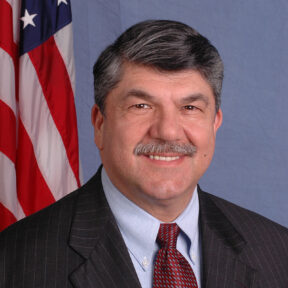
Richard Trumka
Overview
* Former president of AFL-CIO, key player in New Labor Movement
* Former president of the United Mine Workers Union
* Pled the Fifth Amendment to avoid self-incrimination in Teamsters Union money-laundering scandal
* Died on August 5, 2021
Richard Louis Trumka was born on July 29, 1949 in Nemacolin, Pennsylvania, the son and grandson of coal miners. He, too, began working in the mines at age 19 and joined the United Mine Workers of America (UMWA), a member union of the AFL-CIO federation. Trumka served as head of UMWA Local 6290’s safety committee and became an activist in the Miners for Democracy reform movement.
After graduating from Pennsylvania State University in 1971, Trumka earned a degree from Villanova University Law School and was admitted to the Pennsylvania Bar. From 1974-78 he worked on the UMWA legal staff, then returned to the mines. In 1981 Trumka was elected to UMWA’s executive board, and in 1982 he became the union’s international president, a post he would hold for the next 13 years.
During Trumka’s tenure as UNWA president (1982-1995), a number of his union’s strikes were marred by violence. For example:
- In a 1985 strike against the Virginia-based A.T. Massey Coal Company, a union man who crossed the picket line received a serious gash to the head in an attack by angry strikers.
- There was a great deal of violence during a 1989 UMWA strike against the Pittston Coal Company. As the Washington Post described it: “Trumka sustained a nine-month strike in West Virginia that became a rallying cry for a beleaguered labor movement — 4,000 workers submitted to arrest, hundreds came in solidarity from around the country, and all manner of civil disobedience was employed, including spreading bent-nail devices on roads to keep replacement workers from getting in.” Virginia Circuit Court Judge Donald McGlothlin Jr. stated that “the evidence shows beyond any shadow of a doubt that violent activities are being organized, orchestrated and encouraged by the leadership of this union.” The Virginia Supreme Court agreed unanimously with McGlothlin’s findings, saying: “Union officials took active roles in these unlawful activities. Notwithstanding the large fines, the Union never represented to the court that it regretted or intended to cease its lawless actions. To the contrary, the utter defiance of the rule of law continued unabated.”
- In 1993, UNWA thuggery proved fatal. Trumka, in an effort to ensure that no one would be able to find employment as a miner without paying dues or agency fees to the UMWA, ordered more than 17,000 mine workers to walk off their jobs. Moreover, he explicitly instructed striking miners to “kick the sh– out of every last one” of their fellow employees and mine operators who resisted union demands. In response, UMWA enforcers vandalized homes, fired gunshots at a mine office, and cut off the power supply to another mine, temporarily trapping 93 miners underground. Then, on July 22, 1993, a UMWA member shot 39-year-old, non-union worker Eddie York in the back of the head as York was driving home from his Logan County, West Virginia job, killing him. Eight UMWA strikers were present at the scene of the shooting. When guards subsequently came to check on York’s condition, those eight strikers threw rocks at them. Rather take any disciplinary action against the UMWA strikers responsible for the violence, Trumka explained metaphorically: “[I]f you strike a match and put your finger in, common sense tells you you’re going to burn your finger.” In a detailed account of the York case, the Reader’s Digest noted that “UMW President Richard Trumka did not publicly discipline or reprimand a single striker present when York was killed. In fact, all eight were helped out financially by the local.” York’s widow later brought a $27 million wrongful death lawsuit against Trumka and other UMWA officials. After fighting the charges for four years, UMWA lawyers quickly decided to settle out of court in June 1997 once federal prosecutors announced that they planned to release evidence from the trial of Jerry Dale Lowe, whom a federal jury had previously convicted of conspiracy and weapons charges in connection with York’s murder.
In November 1983 in New York City, Trumka was honored at the annual luncheon of the Labor Research Association, a Communist Party USA (CPUSA) front group.
In 1989 Trumka earned a seat on the AFL-CIO’s executive council.
On May 13, 1991, the Workers Defense League, which was influenced heavily by the Democratic Socialists of America, presented Trumka with its David Clendenin Award.
In 1994, Trumka was honored at the annual Eugene Debs Award Banquet in Terre Haute, Indiana; The award was named after the man who founded the Socialist Party of America and ran for U.S. President five times on the Socialist Party ticket.
In 1995 Trumka was one-third of a troika elected to head the AFL-CIO. His running mates for election were John Sweeney, president of the Service Employees International Union (SEIU), and Linda Chavez-Thompson, who had been executive vice president of the American Federation of State, County and Municipal Employees (AFSCME). Calling themselves the “New Voice” of the labor movement, this threesome pledged to change the policies of the moderate AFL-CIO leaders who had preceded them. Trumka would go on to serve as the AFL-CIO’s secretary-treasurer from 1995 to September 2009, second-in-command to its president, John Sweeney.
Trumka, Sweeney, and Chavez-Thompson represented a turn away from blue-collar industrial unionism and the AFL-CIO’s traditional emphasis on raising wages and improving working conditions. Rather, they focused on recruiting ever-growing numbers of government workers who would benefit from higher taxes and bigger government, and who therefore would reliably support socialism and America’s pro-big government Democratic Party.
Soon after winning their election in 1995, Trumka and his fellow triumvirs instituted “Union Summer,” an effort “to recruit and train hundreds of young people as organizers and political activists.” The “Union Summer” indoctrination materials endorsed by Trumka use explicitly anti-capitalist, class-warfare rhetoric, instructing young participants to recite a pledge called “Working Class Commitment” that included the Marxist dogma “that we [union workers] produce the world’s wealth … [and] will end all oppression.” Unlike their more moderate predecessors, Trumka and his fellow AFL-CIO bosses saw free-market capitalism not as essential to worker prosperity but as something to be despised and destroyed. Their ultimate aim was not to boost members’ wages, but to radically transform society. Trumka would confirm this in a September 2010 moment of candor, when he stated that he had gotten “into the labor movement not because I wanted to negotiate wages,” but “because I saw it as a vehicle to do massive social change to include lots of people.”
The agenda of Trumka and his fellow “New Voice” leaders was to promote “class-based organizing,” on the theory — as explained by labor economist Michael Yates — that “those unions which mobilize rank-and-file workers around a program of aggressive solidarity and conflict with their employers have the best chance of winning union elections, bargaining good contracts, and resisting decertification.”
Trumka aggressively developed and promoted radical strategies and tactics like those of the 1960s New Left for signing up workers. These measures included the formation of labor alliances with media, government, and radical activists. The objective was to intimidate companies by threatening to inflict a “death of a thousand cuts” via negative-publicity campaigns, harassment of corporate investors, alliances with government regulators, and more.
Trumka, Sweeney and Chavez-Thompson also rescinded a founding AFL-CIO rule that banned Communist Party members and loyalists from leadership positions within the Federation and its unions. Instead, the “New Voice” triumvirate welcomed Communist Party delegates to positions of power in the Federation. This move to open the previously patriotic union to subversives delighted the CPUSA, which declared itself “in complete accord” with the troika’s new AFL-CIO program. “The radical shift in both leadership and policy is a very positive, even historic change,” wrote CPUSA National Chairman Gus Hall in 1996 about the Trumka/Sweeney/Chavez-Thompson takeover.
In 1996, Trumka was one of approximately 130 people who played a role in helping Robert Borosage and Roger Hickey establish the Campaign for America’s Future. Among the other co-founders were such notables as Mary Frances Berry, Julian Bond, Heather Booth, John Cavanagh, Richard Cloward, Jeff Cohen, Ken Cook, Peter Dreier, Barbara Ehrenreich, Betty Friedan, Todd Gitlin, Heidi Hartmann, Tom Hayden, Denis Hayes, Roger Hickey, Patricia Ireland, Jesse Jackson, Joseph Lowery, Steve Max, Gerald McEntee, Harold Meyerson, Frances Fox Piven, Robert Reich, Mark Ritchie, Arlie Schardt, Susan Shaer, Andrew Stern, and John Sweeney.
When Trumka and his successor as UMWA president, Cecil Roberts, in 1998 made a joint speaking appearance in Bentleyville, Pennsylvania, approximately 50 rank-and-file union members gathered to protest their leaders’ policies. “Within minutes,” wrote leftwing journalist Paul Scherrer, “a group of UMW officials and their supporters attacked the protesting miners … Several miners were punched, knocked to the ground and kicked repeatedly. [One] was hit with a piece of lumber and suffered a large gash on his head. After the attack, UMW President Cecil Roberts justified the assault by saying: ‘This is not the way we want to resolve disputes, but you can’t curse the union and its leadership and expect that no one will take exception to that.’ Richard Trumka refused to answer questions about the assault when asked by a [World Socialist Web Site] reporter.”
In the late 1990s, Trumka twice invoked his Fifth Amendment protection against self-incrimination in a congressional committee investigation of a corruption and money-laundering scandal involving his friend, Teamsters Union president Ron Carey. As the Capital Research Center reports:
“Trumka’s notoriety grew when he endorsed a reputed ‘reformer’ Ron Carey over James Hoffa, Jr. in their battle over who would serve as president of the Teamsters. Trumka, who had become AFL-CIO secretary-treasurer in 1995, was close to Carey, who brought the exiled Teamsters back into the AFL-CIO fold. It didn’t take long for Trumka to be mired in the money-laundering and kickback scandals that enveloped Carey and led to his expulsion from office. As the Washington Post reported, ‘Federal investigators raised questions about whether Trumka improperly directed $150,000 in AFL-CIO funds to Carey’s campaign; Trumka took the Fifth and was not charged.’”
Notably, the AFL-CIO at that time had a policy — instituted in 1957 — stipulating that any union official who chose to invoke the Fifth Amendment should be removed from his position. But Federation president John Sweeney chose to eliminate the rule rather than the rule-breaker Trumka.
During the 2008 U.S. presidential election, Trumka came out strongly in support of Barack Obama, saying that whatever anti-Obama sentiment existed among American voters was largely attributable to the racism of “a lot of white folks” who “just can’t get past the idea that there’s something wrong with voting for a black man.” On another occasion, Trumka put it this way: “There’s not a single good reason for any worker, especially any union member, to vote against Barack Obama. And there’s only one really, really bad reason to vote against Barack Obama. And that’s because he’s not white.”
In February 2009, President Obama named Trumka to his Economic Recovery Advisory Board.
That same month, Trumka spoke at the Blue Green Alliance‘s annual “Good Jobs, Green Jobs” Conference.
In 2009 Trumka was elected president of the AFL-CIO, replacing the retiring John Sweeney. Trumka formally accepted his new position at the Federation’s national convention in Pittsburgh on September 16, where he outlined his short- and long-term priorities for the labor movement. Regarding the fight over the Employee Free Choice Act — i.e., “card check” legislation — he said: “I swear to you that, come hell or high water, we will win.” Trumka also called for increased pension, education, and childcare benefits for union workers; “fair taxes”; “putting Wall Street on a tight leash”; and “bargaining trade laws that create good jobs here at home.” But his topmost priority was to promote the enactment of “health care reform,” which he called “the cornerstone of any progressive economic agenda.” Characterizing Barack Obama as “the most pro-worker president in our time” who was leading “the greatest moral crusade of our time,” Trumka said: “He [Obama] asked us to mobilize our members, their families, and working people all across this nation to join him in this crusade. Well, today our answer to President Obama is: ‘Yes, we can … and yes, we will!’ Yes, we will because, like you, we know we need to build a system that offers the care Americans need at a price America can afford.”
But even as he vowed to help President Obama pass health care reform, Trumka emphasized that his union would not support any legislation that did not include a public option — i.e., a government-run insurance agency to “compete” with private insurers. Because such an agency would not need to show a profit in order to remain in business, and because it could tax and regulate its private competitors in whatever fashion it pleased, this “public option” would inevitably force private insurers out of the industry. “Mr. President, so long as you stand for a public option we are going to stand with you,” said Trumka. “Now, I know we’ve all heard those who’ve said that we ought to be satisfied with a health care reform plan that doesn’t include a public option. They seem to think that we ought to settle for whatever bill a few Republicans will sign on to, declare it a victory, and go home. Well, sisters and brothers, what they need to learn is that there’s a difference between declaring a victory – and actually winning one. And they need to learn something else, too: a plan without a public option may be a lot of things, but it sure as hell isn’t reform!”
On the day of Trumka’s speech in Pittsburgh, the Democrat-controlled Senate Finance Committee proposed a health care bill that not only failed to include a public option, but also imposed a so-called “Cadillac Tax” on the kind of costly, high-benefit health plans that were a part of many union contracts. Said Trumka in response to the bill: “We will fight pretty doggedly attempts to tax benefits because we’ve paid for those benefits over the years – we’ve forgone wage increases, pension increases, days off, and everything else to get those medical benefits.” Though the final health care reform bill — widely known as Obamacare — had no public option and thus did not fully satisfy Trumka, he saw it as a stepping stone toward something better. “[T]he bill is not perfect,” Trumka wrote in a letter to House members. “But we are realistic enough to know it’s time for the deliberations to stop and for progress to begin. And we are idealistic enough to believe this is an opportunity to change history we can’t afford to miss.”
Shortly after the passage of Obamacare, Trumka once again showed the considerable influence he had on President Obama, as the Capital Research Center explains:
“Passing laws is not enough. Savvy operators know that it takes friendly appointees in key positions to implement laws to a special interest’s advantage. To that end, Obama appointed Hilda Solis to be Secretary of Labor and nominated two union lawyers, Craig Becker and Mark Pearce, to tilt the balance on the National Labor Relations Board. Becker, a longtime labor activist, … penned a law review article arguing that the major aims of ‘card check‘ did not require action by Congress but could also be achieved through rulings of the NLRB. This was important because a Senate with 41 Republicans votes could prevent enactment of ‘card check’ legislation. Trumka urged Obama to use his power to make recess appointments of Becker and Pearce when Congress was out of session. On March 27, 2010, four days after he signed the health care bill into law, Obama did just that. The move allows Becker and Pearce to serve without Senate confirmation until the end of 2011.”
Shortly before the 2010 midterm elections, Trumka hosted a conference call with President Obama for thousands of union activists. The labor leader asserted that unions constituted the “firewall” that would protect Democrats from losing their majorities in the House and Senate. In particular, he exhorted union members to support the reelection of Senate Majority Leader Harry Reid of Nevada, who was being challenged by Republican nominee Sharron Angle. Said Trumka on Reid’s behalf: “Do it for Harry Reid! He’s our champion…. Just look at him! Come on! Don’t you love him?… Harry Reid knows what he’s doing. He knows what we need — and how to deliver it.”
All told, Trumka’s AFL-CIO disseminated 28.6 million pieces of literature promoting Democrats in the 2010 midterms. In one letter, Trumka told union members that “as bad as things are, they can get a whole lot worse.” In the end, Democrats suffered one of the most decisive midterm election defeats in American history, losing 6 Senate seats, more than 60 House seats, and 7 governorships. But Trumka was unfazed. The day after the elections, he credited labor unions for having helped Democrats retain a majority in the Senate, albeit a slim one. “We did our job,” he said. “I think [Democrats] are cognizant of what we did and if they aren’t they should pay heed to it.” Moreover, Trumka portrayed the election results as a “mandate for creating jobs and fixing the economy” and as a repudiation of Republican policies. Communist Party USA Labor Commission chairman Scott Marshall, meanwhile, proudly emphasized that his organization had worked hard with Trumka to promote Democrat candidates.
On February 18, 2011, Trumka spoke candidly about the extent of his involvement with the Obama administration, boasting: “I’m at the white House a couple times a week — two, three times a week. I have conversations every day with someone in the White House or in the administration. Every day. And that includes weekends, by the way.”
During the 2012 elections, Trumka and the labor movement doubled down on political spending. Indeed, unions spent approximately $500 million on President Obama’s campaign alone, building a monumental voter-registration, electioneering, and get-out-the-vote machine. AFL-CIO volunteers knocked on almost 14 million doors and registered more than 450,000 new voters nationwide during the campaign season, thereby playing an enormous role in Obama’s victory at the polls. Trumka, for his part, went so far as to claim credit for Obama’s reelection.
Notably, the AFL-CIO’s voter canvassing and mobilization machine was not shut down after Election Day. Rather, Trumka and his Federation pledged to build a long-term, year-round mobilization structure to keep its issues on the front burner constantly, and not just during the election season.
In 2017, Trumka served briefly as a member of President Donald Trump’s American Manufacturing Council. In August of that year, however, he resigned from the Council, stating that he could not work with a president who “tolerates bigotry and domestic terrorism.” Specifically, Trumka said he objected to remarks by which President Trump — in the aftermath of a deadly riot in Charlottesville, Virginia — had voiced what Trumka perceived to be approval of “the KKK and neo-Nazis.” But in fact, Trumka’s assertion was false; Trump had explicitly and repeatedly denounced such organizations — by name.
In 2019, Trumka spoke out against federal immigration raids that netted illegal migrant workers who had been hired by Koch Foods and other meat packers in Mississippi. “We condemn these raids in the strongest possible terms,” Trumka tweeted, “and pledge our full support to @UFCW and the working people of Mississippi as they work to win justice for all those who were unfairly targeted.”
Trumka died on August 5, 2021 in Washington, D.C.
Additional Information
During his career as a union leader, Trumka has aligned himself with the agendas of the Congressional Progressive Caucus on numerous matters, most notably opposition to welfare reform and support for a single-payer healthcare system.
Trumka has served on the Board of Directors of the Economic Policy Institute, which is heavily influenced by the Democratic Socialists of America.
Poul Rasmussen, president of the Party of European Socialists and co-chair of the Global Progressive Forum, has said of Trumka: “This is one of the most progressive people in the United States of America.”
Further Reading:
“Labor’s Monster Man” (by Philip Klein, Capital Research Center, December 2010); “Richard Trumka: An Ugly History of Violence and Corruption” (National Right to Work Legal Defense Foundation, 2009); “Union Gangster: Richard Trumka” (by Matthew Vadum, 9-30-2011); “Richard Trumka” (Keywiki.org).
Additional Resources:
Labor’s Monster Man
By Philip Klein
December 8, 2010