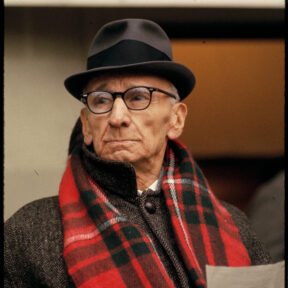
Abraham Johannes Muste
: Photo from Wikimedia Commons / Author of Photo: Gotfryd, Bernard, photographerOverview
* Christian pacifist, labor-union activist, Marxist
* Died on February 11, 1967
Born in Holland on January 8, 1885, Abraham Johannes Muste was brought to the U.S. at age six and was raised in what he would later describe as the “exceedingly orthodox” Calvinist traditions of the Dutch Reformed Church. In the early 1900s, Muste studied at the Union Theological Seminary in New York and was exposed to the teachings of the Social Gospel, a movement that sought to apply biblical principles to the problems associated with industrialization. In 1909 he was ordained as a minister in the Dutch Reformed Church. In the 1912 U.S. presidential election, Muste cast his ballot for the socialist Eugene Debs. Two years later he changed his religious affiliation and became pastor of a Congregational Church.
When World War I broke out in Europe, Muste, inspired by the Christian mysticism of the Quakers, emerged as an outspoken pacifist. In 1919, when textile-industry strikers appealed to the religious community for support, Muste, playing the role of labor-union activist, found himself mired unexpectedly in the turmoil of contentious work stoppages in Massachusetts. Soon thereafter he began working with the newly formed American Civil Liberties Union in Boston and took a church post with the Friends in Providence.
In the early 1920s, Muste became director of the (now-defunct) Katonah, New York-based Brookwood Labor College, whose curriculum focused on the theory and practice of labor militancy. Throughout the decade, he drifted steadily toward revolutionary politics. In 1929 Muste helped form the Conference for Progressive Labor Action, which grew into an openly revolutionary organization and was instrumental in the 1933 establishment of the radical American Workers Party, in which Muste was the major player.
Around that same time, Muste abandoned his Christian pacifism and became a Marxist-Leninist who merged his group with James Cannon’s Trotskyist movement, forming the Workers Party of America. But in 1936, Muste, troubled by certain elements of revolutionary activity, traveled to Norway and met personally with Leon Trotsky; when he returned from that trip, Muste again proclaimed himself a Christian pacifist.
While remaining active in the labor movement, Muste in 1940 began a 13-year stint as the executive secretary of Fellowship of Reconciliation (FOR), a religious pacifist organization. He also sponsored the founding and early work of the Congress of Racial Equality, and he defended conscientious objectors during World War II.
In 1942, with the U.S. involved in two military fronts, Muste published War Is the Enemy, a pamphlet wherein he presented a “Pacifist Proposal” stipulating that: “no attempt [should] be made to fasten sole war-guilt on any nation or group of nations”; all nations should collaborate to build a “federal world government”; the wealthy U.S. should “offer to invest the billions which it would otherwise devote to war preparation and war, in a sound international plan for the economic rehabilitation of Europe and Asia”; America should launch a national program “to provide decent housing,… adequate medical and hospital service, and equal educational facilities for all”; and all nations should dispose of their war armaments “as rapidly as possible.”
In 1953 Muste retired from his position with FOR and became the leader of the Committee for Nonviolent Action, an organization whose members engaged in anti-nuclear activism. He also emerged as a prominent figure in the anti-Vietnam War movement, personally taking part in a number of widely publicized civil-disobedience events.
In 1956-57, Muste co-founded the monthly antiwar journal Liberation, which served as a key forum for radical views during the rise of the New Left. He also organized the American Forum for Socialist Education, in an effort to unify socialists, pacifists, and disaffected Communists into a left-wing coalition soon after the Stalin and McCarthy eras had ended.
In its biography of Muste, the A.J. Muste Memorial Institute notes that its namesake “was close to the emerging liberation movements in Africa” during the 1950s and ’60s. Indeed, he helped organize the World Peace Brigade which worked closely with Kenneth Kaunda of Zambia and Julius Nyerere of Tanzania.
During the Cold War with the Soviet empire, Muste issued a call for America’s unilateral disarmament. In 1961 he used diplomacy to pave the way for a team of pacifists to publicly carry that message in a much-heralded trek from San Francisco all the way to Moscow’s Red Square.
A passionate opponent of American efforts to prevent a Communist takeover of South Vietnam, Muste in 1966 led a group of American pacifists to Saigon, South Vietnam, where, after trying to demonstrate for peace, they were arrested and deported. In January 1967, Muste traveled to North Vietnam with a delegation of clergy and met with the Communist dictator Ho Chi Minh. A few weeks later, on February 11, 1967, Muste died in New York City.
In 1974 a group of self-proclaimed pacifists established the A.J. Muste Memorial Institute in Muste’s memory.
Further Reading: “A.J. Muste’s Life of Activism” (AJMuste.org); Encyclopedia of the American Left, edited by Buhle, Buhle, and Georgakas (University of Illinois Press, 1992), p. 500.