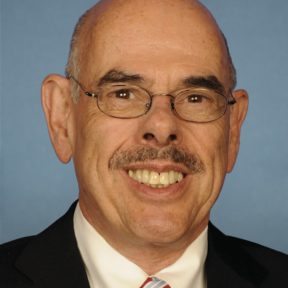
Henry Waxman
: Photo from Wikimedia Commons / Author of Photo: United States CongressOverview
* Represented California in the House of Representatives from 1975-2015
* Favors government-controlled universal health insurance for all Americans
* Facilitated the 2004 efforts of antiwar activists to deliver $600,000 worth of cash and medical supplies to the families of terrorist insurgents in Iraq
* Co-sponsored a 2009 bill calling for the creation of a “[cap-and-trade](../viewSubCategory.asp?id=826)” arrangement mandating reductions in greenhouse gas emissions
Born in Los Angeles, California on September 12, 1939, Henry Arnold Waxman earned a B.A. in political science from UCLA in 1961 and a J.D. from UCLA Law School in 1964. He served three terms in the California Assembly from 1969 until 1974, at which time he was elected to represent California’s 30th Congressional District. Waxman then went on to serve for the next 40 years in the U.S. House of Representatives, where he was also a longtime member of the Congressional Progressive Caucus.
A leading financial backer of Waxman’s many political campaigns was the American Association for Justice, formerly known as the Association of Trial Lawyers of America. Waxman also drew strong support from the members and political action committees of large and powerful labor unions like AFSCME and the SEIU.
In addition, Waxman received the endorsement of the Democratic Socialists of America.
In the 1980s, Waxman worked to expand eligibility for Medicaid, which provides health insurance to low-income people.
In 1990, Waxman played a major role in passing an update to the Clean Air Act. This 1990 law basically mandated that gasoline be mixed with one of two fuel additives: MTBE, which has since been banned in 25 states for contaminating groundwater, or ethanol, which is now widely regarded as a corporate-welfare boondoggle that harms the environment.
In the late 1990s, Waxman helped create the Children’s Health Insurance Program (CHIP), which extended insurance to children from low-income families that earned too much to qualify for Medicaid.
In 2003 Waxman served on the Progressive Majority Advisory Committee.
In December 2004, Waxman and three fellow Democrats — Senator Barbara Boxer, Congressmen Raul Grijalva, and Dennis Kucinich — wrote diplomatic courtesy letters on behalf of a contingent of antiwar activists who, in an effort to draw attention to “the unjust nature” of the Iraq War, wished to personally deliver a combined $600,000 in cash and medical supplies to the families of the terrorist insurgents who were actively fighting American troops in Fallujah. Those traveling in the contingent were representatives of the mission’s sponsoring organizations, which included Code Pink, Global Exchange, Iraq Occupation Watch, the Middle East Children’s Alliance, Peace Action, Physicians for Social Responsibility, Project Guerrero Azteca for Peace, United for Peace and Justice, and Voices in the Wilderness. The most prominent individual participants were Medea Benjamin, and Jodie Evans.
In 2006 Waxman held Congressional hearings on what he characterized as excessive profiteering by contractors who were engaged in rebuilding projects in war-torn Iraq. Similarly, Waxman called for limits on the profits of oil and pharmaceutical companies, which he portrayed as predatory and exploitative enterprises.
In 2007 Waxman served as an advisory-committee member with the Jewish Fund for Justice, a forerunner to Jewish Funds for Justice, which advocates wealth-redistribution as a means of combating America’s “gross economic inequality.” Waxman has also served on the advisory committee of the Progressive Majority; he is a supporter of Public Citizen; and he has been a member of the Sierra Club.
In the summer of 2008, Waxman, who supported the lifting of the U.S. ban on travel to Cuba, dispatched a staffer named Andrew McCanse Wright to conduct a nine-day “fact-finding mission” in that country. The trip was funded by a grant from the Center for Democracy in the Americas, which has ties to the Institute for Policy Studies.
In November 2008, Waxman told the Hamas-linked Council on American-Islamic Relations (CAIR): “CAIR’s vision to promote justice and mutual understanding is essential to our nation. I commend CAIR for its dedication in encouraging the American Muslim population to take a more active role in the government.”
Waxman was a primary author of the Consumer Product Safety Improvement Act (CPSIA) of 2008 — a law that, according to the American Enterprise Institute, “devastated small toymakers and wreaked havoc on second-hand stores with burdensome one-size-fits-all regulation.”
When the House of Representatives voted by a 345-75 margin to defund the notoriously corrupt community organization ACORN in September 2009, Waxman was one of the 75—all Democrats—who voted to continue funding the group.
Waxman identified environmental and healthcare-related issues as his chief legislative priorities. Regarding the former, he is best known for having collaborated with Rep. Ed Markey (D-Massachusetts) in March 2009 to sponsor the 1,200-page American Clean Energy and Security Act, popularly dubbed the Waxman-Markey Act. This legislation’s signature program was a “cap-and-trade” arrangement mandating steep reductions in greenhouse-gas emissions, coupled with punitive taxes on any businesses exceeding their predetermined emissions allowances. After Waxman-Markey was passed by a 219-to-212 vote in the House of Representatives, Americans for Tax Reform — a non-partisan group that “opposes all tax increases as a matter of principle” — reported that Waxman, on the day before the cap-and-trade vote was conducted, had tried to influence the votes of uncommitted House Democrats by transferring at least $16,000 in campaign contributions to their coffers.
Regarding healthcare, Waxman favored an expansion of Medicare and Medicaid coverage and, ultimately, the establishment of a single-payer, universal health insurance system for all Americans. He was a strong backer of Health Care For America Now, an organization that likewise advocated a single-payer model. During the healthcare debate of 2009-10, however, Waxman — conceding that a single-payer system was unlikely to be politically feasible — called instead for the inclusion of a “public option” in any new legislation, whereby a government insurance agency would “compete” with private insurers and inevitably drive them out of business.
In the 2010 election season, as Waxman’s Commerce Committee played a major role in writing the Patient Protection & Affordable Care Act (Obamacare), Waxman was one of Congress’s leading recipients of money from the health insurance industry. The American Enterprise Institute reports that “many destructive provisions of Waxman’s bill survived in the final Obamacare bill, including the individual mandate, the employer mandate, and rules that outlaw[ed] many health plans and thus led to millions of [insurance policy] cancellations in late 2013.”
As matters of principle, Waxman strongly believes that:
- all women should have an unrestricted right to abortion-on-demand at any stage of pregnancy – subsidized by taxpayers, in cases of economic hardship;
- public and private employers alike should be legally required to implement affirmative-action hiring and promotion policies that give preference to African Americans and women, as compensation for historical injustices;
- the principle of church-state separation is inviolable and should preclude permitting prayer in the public schools, or the posting of the Ten Commandments in public places;
- the Affordable Care Act (Obamacare) is an excellent statute that can serve a strategic stepping stone toward the eventual implementation of a government-run, single-payer healthcare system;
- voucher programs designed to enable low-income parents to send their children to private schools rather than to failing public schools, constitute bad policy because they rob the public schools of vital resources;
- the death penalty is applied in a racially discriminatory manner, constitutes cruel and unusual punishment, and should be abolished;
- more guns in the hands of private citizens inevitably result in higher levels of crime, thus the availability of firearms should be restricted by whatever means are effective;
- wealthy people should be required to pay much higher tax rates than those who earn less;
- restrictions on immigration are basically racist because they tend to prevent Hispanics and other non-whites from entering the United States;
- social services should be available to all U.S. residents regardless of their immigration status;
- illegal aliens should be offered amnesty if they have been productive members of society;
- voter ID laws are, by and large, racially motivated attempts to suppress minority voting and should be eliminated;
- an ever-increasing reliance on “green energy” sources such as wind and solar should be put in place, along with the phasing out of fossil fuels, the imposition of carbon taxes, and the raising of vehicle CAFE standards;
- federal spending on infrastructure projects and job programs is crucial to the success of any economic recovery program; and
- the nationalization of banks and corporations is preferable to federal bailouts of those entities.
For an overview of Waxman’s legislative voting record on a variety of major issues, click here.
In January 2014, Waxman announced that he planned to retire from Congress at the end of his then-current term. He vacated his seat in the U.S. House in January 2015.
For additional information on Henry Waxman, click here.
Further Reading: “Henry Waxman” (Votesmart.org, KeyWiki.org); “The Liberal Legacy Henry Waxman Will Leave Behind” (MSNBC.com, 1-30-2014, re: Medicaid expansion, CHIP); “Farewell to Henry Waxman, Maker of Bad Laws” (AEI.org, February 3, 2014, re: Clean Air Act, CPSIA, Commerce Committee’s role in writing Obamacare); “Did Dems Buy Cap and Trade Votes?” (Human Events, 8-5-2009, re: Waxman’s $16,000); “Henry Waxman on VoteMatch [His Positions on Key Issues]” (OnTheIssues.org).
Additional Resources:
Farewell to Henry Waxman, Maker of Bad Laws
By The American Enterprise Institute
February 3, 2014