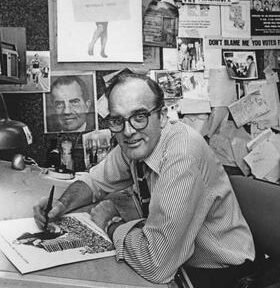
Paul Conrad
: Photo from Wikipedia / Author of Photo: Author UnknownOverview
* Longtime editorial cartoonist for the Denver Post and the Los Angeles Times
* Died on September 4, 2010
Paul Francis Conrad was born on June 27, 1924, in Cedar Rapids, Iowa. He served in the U.S. Army during World War II and received a B.A. in art from the University of Iowa in 1950. After completing his education, Conrad took a job as an editorial cartoonist with the Denver Post, where he worked until the Los Angeles Times hired him away in 1964. Conrad stayed with the Times for the next 29 years.
Outspoken and forthright about his leftist politics, Conrad once said: “No one’s ever accused me of being objective.” According to the New York Times, he “was a Democrat with liberal leanings and relished attacking Republicans.” Conrad became famous for his withering attacks on political figures – especially conservatives. The best cartoons, he believed, were those that contained no words at all, using only pictures to comment on what Conrad called the “political, social and moral injustices” of our time. As The Guardian once observed: “Conrad’s cartoons were hardly ever funny. With an economy of words – using a label but no dialogue – he presented a harsh, dramatic picture that mostly told its own story, often symbolically, and with a jolt. Underneath would appear a caption, often a short title, an ironic remark, or a quotation.” “Caricatures were not his forte, and sometimes a likeness was not striking,” The Guardian added. “But the message was.” Conrad himself acknowledged that his cartoons were “90% idea and 10% drawing.”
When it came to commenting on American culture, Conrad focused largely on the negative. In a cartoon that appeared shortly after the 1965 Watts riots in California, for instance, he drew a group of white men gathered around a black man who was seated on a therapist’s couch, saying to him: “You’ve mentioned unemployment, housing, education, police brutality and despair … but, what was the reason for the riot?”
Conrad gained his greatest renown for the way he skewered particular high-profile political figures. So searing were his depictions of President Richard Nixon, for instance, that they earned the cartoonist a spot on Nixon’s infamous “enemies list” in 1973 – a distinction Conrad welcomed as a sure sign of his own effectiveness. In one particularly famous cartoon, Conrad portrayed an agitated Nixon sitting, with pen in hand, at a large desk covered by long, serpentine scrolls of names – titled “Enemies List.” The caption of the cartoon read, “His Own Worst Enemy.” As James Rainey of the L.A. Times observed, Conrad’s renderings of Nixon invariably showed the President with “brow furrowed, eyes ringed with dark shadows, head slumped into rounded shoulders – helping to cement the image of a desperate, paranoid chief executive.”
Another Conrad cartoon, published during the Watergate crisis, showed Nixon nailing himself to a cross. And yet another one depicted Nixon tied to the ground, Gulliver-style, with ribbons of recording tape rather than rope, while he was quoted saying: “The United States must not become a pitiful, helpless giant.”
Following Nixon’s precipitous fall from grace in the Watergate affair, Conrad’s attacks on him became still more relentless. After Nixon’s death in 1994, the cartoonist became incensed at those who uttered even the barest praise for the deceased former president. “I think it’s sick,” fumed Conrad. “We know what the bastard did.” Conrad penned his own eulogy for Nixon: a cartoon drawing of the late president’s gravestone with the inscription: “Here lies Richard Nixon” – suggesting that Nixon’s mendacity would persist for all eternity.
Conrad openly detested Ronald Reagan as well. The cartoonist’s antipathy for Reagan actually had its roots in the 1960s, when the latter began his tenure as governor of California. At that time, Conrad depicted the actor-turned-politician as a bumbling, intellectually deficient, mean-spirited individual who understood nothing about the concerns of ordinary folk, and who had stumbled into politics only as a fortuitous result of his celebrity. In 1968, Conrad drew Governor Reagan on his knees, retrieving papers marked ”law and order,” ”patriotism,” and ”individual liberty,” from under the feet of Democrat presidential candidate George Wallace of Alabama. ”Excuse me, Mr. Wallace,” said Reagan in the cartoon, ”you’re stepping on my lines.” Conrad also depicted Reagan as a modern-day Napoleon, ”The War Powers Actor.”
When Reagan in 1973 proposed a ballot measure to restructure the tax system of California, Conrad characterized the governor as “Reagan Hood,” soaking the poor in order to give their money to the rich. After Reagan’s election to the Oval Office in 1980, Conrad condemned the president’s military buildup as a foolhardy endeavor whose funding was made possible only by draconian cuts to vital social-welfare programs. On another occasion, Conrad drew a panel that showed Reagan plotting a fascist putsch in a Munich beer hall.
Conrad once portrayed Vice President Dick Cheney standing in a vast graveyard of military veterans and saying, ”For seven years, we did everything to keep you safe.” He drew Nixon and George W. Bush side by side, with the caption ”Tweedledumb and Tweedledumber.” And after the 2008 presidential election, Conrad depicted Governor Sarah Palin of Alaska, the Republicans’ defeated vice-presidential candidate, holding a smoking AK-47 in one hand and, in the other, the trunk of a dead G.O.P. elephant.
But Mr. Conrad did not entirely spare Democrats from his ridicule and sarcasm. For instance, he once cast President Lyndon Johnson and Vice President Hubert Humphrey as cowboys riding a bomb as it descended upon Vietnam in 1968. Years later, when Robert S. McNamara expressed regrets over the war, Conrad drew the former defense secretary at the Vietnam Veterans Memorial in Washington, saying, “Sorry about that.” And when Bill Clinton published his memoir, My Life, in 2004, Conrad restyled the cover and the title as “My Lie.”
Conrad generally viewed America as the antagonist in any international conflicts involving the U.S. He also held a negative view of Israel, which he portrayed as a habitual abuser of human rights and an agent of mass murder. In the early 1980s, Conrad drew a Star of David formed by the corpses of Palestinians. In a 2002 cartoon, he showed an Israeli airplane flying directly toward a pair of high-rise mosques bearing an unmistakable resemblance to the Twin Towers that had once stood in lower Manhattan.
During his 43 years as an editorial cartoonist, Conrad won the Pulitzer Prize for editorial cartooning in 1964, 1971, and 1984. He also won two Overseas Press Club awards (1970 and 1981). Conrad’s tenure with The New York Times ended in 1993 when he accepted a buyout from the paper. His cartoons were subsequently syndicated in publications that had been printing his work for many years.
In addition to his work as a cartoonist, Conrad was also an accomplished sculptor. He made limited-edition bronzes of political leaders, including Reagan (as the aforementioned “Reagan Hood”); John F. Kennedy; Anwar Sadat (as Pharaoh); Golda Meir; Abraham Lincoln; Martin Luther King (breaking a chain); Hillary and Bill Clinton (as the Janus-faced “Billary”); and George W. Bush (depicted as a cowboy hat and boots). He also sculpted George Bush Sr. hula-hooping, because of his claim to have been “out of the loop” in the Iran-Contra affair in the mid-1980s.
Conrad died on September 4, 2010. At his funeral, eulogies were delivered by journalist Robert Scheer and editorial cartoonist Tony Auth.
Further Reading: “A Cartoonish Worldview” (by John Perazzo, 9-13-2010); “Paul Conrad, 86, Cartoonist Whose Pen Spared None” (NY Times, 9-6-2010); “Paul Conrad: R.I.P.” (NRLC.org, 9-2-2010); “Paul Conrad Obituary” (The Guardian, 9-15-2010); “Paul Conrad Dies at 86” (Los Angeles Times, 9-5-2010).