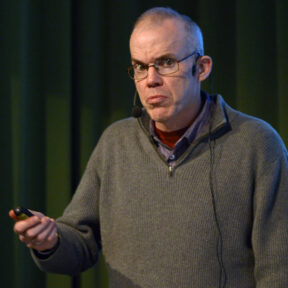
Bill McKibben
: Photo from Wikimedia Commons / Author of Photo: Frankie FouganthinOverview
* Founder and head of the global environmentalist campaign 350.org
* Believes that American “hyper-individualism” and consumerism corrupt both the environment and humanity
* Promotes the notion that anthropogenic global warming will result in environmental catastrophe
Emergence of a Young Activist
William (Bill) Ernest McKibben was born on December 8, 1960 in Palo Alto, California, and was subsequently raised in the Boston suburb of Lexington, Massachusetts. His father, Gordon McKibben, was a journalist with Business Week magazine before becoming business editor at The Boston Globe in 1980. When the elder McKibben was arrested at a 1971 anti-Vietnam War demonstration, young Bill, who was also present at the event, was, according to his mother, “furious that he wasn’t allowed to be arrested with his father.” “It really had an impact on him,” the mother stated. “It taught him that you stand up for what you believe.”
Ideological Evolution During His College Years
In 1978 Bill McKibben enrolled at Harvard University, where he served as president of the student newspaper, the Harvard Crimson, in 1981 — the year before he graduated. A decade and a half later, in a 1996 article titled “Job and Matthew,” McKibben would recall how his college years had been marked by a persistent effort to attain some form of victim status:
“My leftism grew more righteous in college, but still there was something pro forma about it. Being white, male, straight, and of impeccably middle-class background, I could not realistically claim to be a victim of anything. Not for lack of trying—in one short but loony phase, I convinced myself that I was Irish-American and wore black armbands when Bobby Sands and his IRA companions starved themselves to death [in a hunger strike]. Mostly, I supported everyone else—marched in Take Back the Night marches, signed petitions for [the creation of] minority centers and Hispanic studies, conspicuously sat at dinners with gays and lesbians during gay and lesbian week.”
In that same 1996 piece, McKibben wrote that in his college days, he had first become intrigued by the tenets of liberation theology, a movement that: (a) sprang from Roman Catholicism; (b) maintained that impoverished people merited special attention and respect from Christian churches; and (c) advocated for the overthrow of the social and economic systems that allegedly contributed to the oppression of such people. Wrote McKibben:
“In those early years of the 1980s, with Reaganism ascendant and Lech Walesa busily proving to anyone who had not yet figured it out that communism was a stinking corpse, the only promising strain of ‘leftism’ seemed to emanate from Latin America. And it was less the Sandinistas that fascinated me than the liberation theologians, who seemed to be issuing a coherent and genuinely popular response to the poverty and violence around them.
McKibben saw the rise of Reagan as a disastrous development vis-a-vis environmental concerns. Many years later, in 2008, he would recall how Reagan’s election as president in 1980 was “the choice for a kind of pretend America where we would agree that we didn’t have to face [economic or environmental] limits, change any [economic or environmental] habits.” “It’s in defiance of that trend,” he explained, “that I’ve spent the succeeding years writing….”
In 2010, McKibben again invoked memories of Reagan, stating that the former president’s “sunny optimism” had actually posed a threat to the nation’s environmental well-being. “He really believed it was morning again,” wrote McKibben, “and when the economy turned up,… the ambivalence about [unrestrained economic and industrial] growth vanished, and it was our last real chance to avert disaster.” “America,” he added, “has spent the last 25 years living in the shadow of Reagan, as political leaders from both parties laughed at the idea that there might be limits to growth.”
Joining the “Global Warming” Conversation
Upon his graduation from Harvard, McKibben became a writer for The New Yorker and remained there until 1987. After leaving that publication, he spent several years as a freelance writer in New York’s Adirondack Mountains.
With the issue of global warming gaining increased public attention after the hot summer of 1988 and a slew of horrific wildfires that ravaged Yellowstone National Park that same year, McKibben published his first contribution to that conversation: a December 1988 piece in The New York Review of Books titled, “Is the World Getting Hotter?” Some excerpts:
“For most Americans, last summer was one of the hottest on record. Some experts said the heat may have been a sign of what to expect from the ‘greenhouse effect’—the increased levels of carbon dioxide in the atmosphere as the result of burning fossil fuels. The carbon dioxide traps the sun’s infrared radiation close to the planet’s surface and causes the temperature to rise. Other experts said no: last summer’s heat was simply weather.
“This debate is not new. […] In 1958, as a part of the International Geophysical Year, a Scripps [Institute of Oceanography] scientist established a monitoring station 11,150 feet up the side of Mauna Loa in Hawaii, high enough above civilization for uncontaminated readings. In fairly short order, the data revealed a clear pattern […] Carbon dioxide was marching upward—concentrations in the atmosphere were rising at a rate of about one part per million each year. The rate has since increased to 1.5 parts per million annually for a total concentration to reach this year about 350 parts per million.”
The End of Nature: McKibben’s Highly Influential Book on Global Warming
Before devoting himself fully to environmental activism, McKibben produced a series of books on the subject. The first of these was The End of Nature (1989), an impactful publication that is considered the first highly popular book for a general audience about climate change—which at that time was commonly referred to as the “greenhouse effect.” Emphasizing the threat of an imminent global-warming catastrophe, the book suggested that the earth was headed for environmental destruction as a result of human industrial activity. The only hope for preventing such a calamity, said the book, would be to implement far-reaching intergovernmental regulations and to dramatically alter the polluting lifestyles of Western cultures.
As author Stanley Kurtz, a senior fellow at the D.C.-based Ethics and Public Policy Center, explains, The End of Nature marked the dawn of an era when McKibben “almost singlehandedly turned global warming into a public issue.” And this, says Kurtz, enabled McKibben to satisfy the yearning he had long felt—at least since his days at Harvard—to be able to claim that he was a victim of some oppressive force: “Now everyone could be a victim” (Kurtz’s words)—of global warming.
Advocating a Limit of One Child Per Family
Among McKibben’s more controversial works was his 1999 book, Maybe One: A Case for Smaller Families, in which he argued that one-child families were ethically superior to their larger counterparts because the existing rate of human population growth was detrimental to the environment. The author went so far as to reveal that those very same considerations had led him to have a vasectomy after the birth of his daughter in 1993.
Portraying Radical Environmentalism as a Christian Mandate
Contending that Christian ethical teachings are coextensive with left-wing politics, McKibben has embraced biblical interpretations which construe the anti-capitalist tenets of radical environmentalism as embodiments of Christian morality. In an August 2005 essay, for example, he derided the United States as a nation of hypocrites who, while professing their devotion to biblical principles, routinely ignored what he viewed as Christian mandates for wealth redistribution and socialized economies — as well as open borders and soft criminal-justice policies:
“America is simultaneously the most professedly Christian of the developed nations and the least Christian in its behavior. That paradox … illuminates the hollow at the core of our boastful, careening culture. […]
“Christ was pretty specific about what he had in mind for his followers. What if we chose some simple criterion—say, giving aid to the poorest people—as a reasonable proxy for Christian behavior? After all, in the days before his crucifixion, when Jesus summed up his message for his disciples, he said the way you could tell the righteous from the damned was by whether they’d fed the hungry, slaked the thirsty, clothed the naked, welcomed the stranger, and visited the prisoner. What would we find then? In 2004, as a share of our economy, we ranked second to last, after Italy, among developed countries in government foreign aid. Per capita we each provide fifteen cents a day in official development assistance to poor countries…. In fact, by pretty much any measure of caring for the least among us you want to propose—childhood nutrition, infant mortality, access to preschool—we come in nearly last among the rich nations, and often by a wide margin. […]
“This Christian nation also tends to make personal, as opposed to political, choices that the Bible would seem to frown upon. Despite the Sixth Commandment, we are, of course, the most violent rich nation on earth, with a murder rate four or five times that of our European peers. We have prison populations greater by a factor of six or seven than other rich nations…. Having been told to turn the other cheek, we’re the only Western democracy left that executes its citizens, mostly in those states where Christianity is theoretically strongest. […]
“[I]t was my work with religious environmentalists that first got me thinking along the lines of this essay. We were trying to get politicians to understand why the Bible actually mandated protecting the world around us (Noah: the first Green), work that I think is true and vital. But one day it occurred to me that the parts of the world where people actually had cut dramatically back on their carbon emissions, actually did live voluntarily in smaller homes and take public transit, were the same countries where people were giving aid to the poor and making sure everyone had health care—countries like Norway and Sweden, where religion was relatively unimportant. How could that be? For Christians there should be something at least a little scary in the notion that, absent the magical answers of religion, people might just get around to solving their problems and strengthening their communities in more straightforward ways.
“But for me, in any event, the European success is less interesting than the American failure. Because we’re not going to be like them. Maybe we’d be better off if we abandoned religion for secular rationality, but we’re not going to; for the foreseeable future this will be a ‘Christian’ nation. The question is, what kind of Christian nation?”
Combating Carbon Emissions: “Step It Up” Becomes “350.org”
In 2007 McKibben led the so-called “Step It Up” campaign, an anti-global-warming initiative that was funded, in part, by the Rockefeller Brothers Fund and the Rockefeller Family Fund. Demanding that Congress place restrictions on carbon emissions—with the aim of reducing global warming pollution by 80% by the year 2050—“Step It Up” soon went international and adopted the name 350.org.
Advocating De-Development
Much of McKibben’s writing extols the virtues of “de-development.” In the author’s view, mankind’s ever-increasing technological and industrial progress corrupts not only the natural environment, but human nature as well. For instance, in his 2003 book Enough: Staying Human in an Engineered Age, McKibben wrote:
“They’ll lead us … toward the revolutionary idea that we’ve grown about as powerful as it’s wise to grow; that the rush of technological innovation that’s marked the last five hundred years can finally slow … But those decisions will only emerge if people understand the time for what it is: the moment when we stand precariously on the sharp ridge between the human past and the posthuman future, the moment when meaning might evaporate in a tangle of genes or chips…. These new technologies are not yet inevitable. But if they blossom fully into being, freedom may irrevocably perish. This is a fight not only for the meaning of our individual lives, but for the meaning of our life together.”
Stanley Kurtz describes McKibben as a “communitarian leftist” who: (a) is “profoundly hostile to modernity”; (b) is “fine with wealth redistribution and reshaping the economy via regulatory decree”; (c) wants “a government-primed revival of pre-industrial communal life”; and (d) believes that, in the past, a “world of tight families and interdependent neighbors … was far more satisfying than our hyper-individualist, consumer-driven, tech-saturated present.” (All the quoted words are Kurtz’s.)
McKibben’s 2007 book Deep Economy, and his 2010 book Eaarth: A Guide to Living on a Fundamentally Altered Planet, both delivered the author’s characteristically anti-economic-growth, anti-technology message advocating what he called the “controlled decline” of modern industry. McKibben wrote in Eaarth that when he had published The End of Nature in 1989, “It was [still] too early to see the practical effects of climate change but not too early to feel them.”
Stanley Kurtz distills McKibben’s core objective down to its essence:
“He is arguing for a return to relatively self-sufficient local communities, especially when it comes to food. Modern agriculture feeds huge numbers of people at a very low price. Yet industrial farming is carbon-intensive, from the fertilizers, to the combines, to the planes and ships that transport all that produce around the globe. McKibben wants to undo this system with a large-scale return to the land. Labor-intensive (rather than carbon-intensive) agriculture would form the nucleus of a new, quasi-peasant society. Relatively self-sufficient local farming communities would be protected not only from global warming, but from capitalism’s cycles of boom and bust.
“It’s a sweeping vision, encompassing not only a return to rural areas, but a new, decentralized food-production system extending from the rural farms to suburban backyards to urban rooftops. Americans would consume pretty much only locally grown food. Many would go vegetarian, while the rest of us would use meat more as a garnish than as the center of our meals. Food would cost more, choice would be drastically reduced, and putting meals together would take a great deal more effort than it does today. Automobiles would become rare and expensive, and transcontinental and transoceanic air travel would largely be replaced by Internet-based video chats and cyber-tourism. McKibben even wants to develop local forms of money designed to keep goods close to their points of origin.
“De-linking localities from national and global economies would reduce growth and spell the end of the consumer society. The fabulous array of choices provided by modern capitalism would disappear. Yet this unwinding of modernity and the associated sacrifice of economic growth are the prices we must pay to save the planet from catastrophic warming. Or so McKibben says.”
When Deep Economy (2007) and Eaarth (2010) were published, McKibben routinely supplemented his warnings about climate change with claims that the world was rapidly “running out of oil.” But soon thereafter, hydraulic fracturing (fracking) and other technologies for accessing oil and gas reserves ushered in a new era where it became evident that fossil fuels were present in great abundance in the United States. Quickly assimilating this newfound information, McKibben discontinued his previous warnings about a dwindling supply of oil, even as he held fast to his position that oil was toxic to the environment. “Now that he has realized that there’s actually ‘too much’ fossil fuel in the ground, his efforts to bottle it up are a last-ditch move to salvage his no-growth goal,” writes Stanley Kurtz. McKibben’s “real goal,” adds Kurtz, “is to delegitimize the carbon-fuel industry, thereby creating a mass movement with enough political power to bottle up most of our fossil energy resources, unused.”
Praise for Communist Cuba
In the early 2000s, McKibben praised the agricultural sector of Communist Cuba—a politically isolated country whose agriculture is organic and localized, as he prefers — chiefly because it had little access to pesticides and external markets.
Accolades for McKibben
In 2009, Foreign Policy magazine named McKibben to its inaugural list of the “Top 100 Global Thinkers.”
That same year, MSN Lifestyle named him one of the world’s 12 most influential men.
In 2010, the Boston Globe called McKibben “probably the nation’s leading environmentalist.”
In 2012, American University Shorenstein Fellow Matthew C. Nisbet called McKibben “arguably the most prominent climate change
activist in the United States.”
In March 2013, Stanley Kurtz described McKibben as “arguably America’s most influential environmentalist.”
Also in 2013, McKibben became the first environmentalist to receive the Gandhi Peace Award.
Former Boston Globe investigative reporter Ross Gelbspan has described McKibben as “the godfather of all popular works of climate literature that have followed
his first book” (The End of Nature).
Denouncing “Climate Change Denialism”
According to McKibben, people who doubt that anthropogenic global warming poses a grave and imminent threat to life on earth suffer from “climate change denialism.” He also has claimed that such disparate events as Hurricane Katrina (in 2005) and the unusually severe snowstorms that struck Washinton, D.C. in 2010 were uniformly the consequences of climate change. As McKibben wrote in a February 2010 opinion piece in The Washington Post:
‘[T]he weird and disruptive weather patterns around the world are pretty much exactly what you’d expect as the planet warms. Here’s how it works:
“In most places, winter is clearly growing shorter and less intense. We can tell, because Arctic sea ice is melting, because the glaciers on Greenland are shrinking and because a thousand other signals send the same message. Here in the mountains of the Northeast, for instance, lakes freeze later than they used to, and sometimes not at all: Lake Champlain remained open in winter only three times during the 19th century, but it did so 18 times between 1970 and 2007.
“But rising temperature is only one effect of climate change. Probably more crucially, warmer air holds more water vapor than cold air does. The increased evaporation from land and sea leads to more drought but also to more precipitation, since what goes up eventually comes down. The numbers aren’t trivial — global warming has added 4 percent more moisture to the atmosphere since 1970. That means that the number of ‘extreme events’ such as downpours and floods has grown steadily; the most intense storms have increased by 20 percent across the United States in the past century.
“So here’s the thing: Despite global warming, it still gets cold enough to snow in the middle of winter. It even gets cold enough to snow in Texas and Georgia, as it did late last week. And the chances of what are technically called ‘big honking dumps’ have increased. As Jeff Masters, the widely read weather blogger, pointed out last week, a record snowstorm requires a record amount of moisture in the air. ‘It is quite possible that the dice have been loaded in favor of more intense Nor’easters for the U.S. Mid-Atlantic and Northeast, thanks to the higher levels of moisture present in the air due to warmer global temperatures,’ he wrote.
“The climatalogical climate is only part of the equation. The political climate counts, too — and there’s no question that it’s harder to make legislative progress when Sen. James Inhofe’s grandchildren are building an igloo next to the Capitol with a big sign that says “Al Gore‘s New Home.” The timing here is particularly tough, for the snowstorms come against the backdrop of renewed attacks on the pillars of climate science — charges that hacked e-mails show some researchers to be venal or that key scientists have financial ties to energy industries.
“Looked at dispassionately, those political attacks essentially buttress the consensus around global warming. If that much money and attention can be aimed at the data and all anyone can find is a few mistakes and a collection of nasty e-mails, it’s a pretty good sign that the science is sound (though not as good a sign as the melting Arctic). The British newspaper the Guardian just concluded a huge series on the ‘Climategate’ e-mails with the words: ‘The world is still warming. Humanity is still to blame. And we still, urgently, need to do something about it.'”
Condemning “Materialism” & “Hyperindividualism”
Identifying the United States as the world’s chief polluter, McKibben attributes that vice to a combination of American “materialism” and “hyperindividualism”—i.e., people’s desire to live in large houses situated far from densely populated areas. In McKibben’s view, European-style collectivization is not only more environmentally friendly than capitalism, but is also more conducive to human happiness. As he wrote in April 2010:
“Access to endless amounts of cheap energy made us rich, and wrecked our climate, and it also made us the first people on earth who had no practical need of our neighbors.
“In the halcyon days of the final economic booms, everyone on your cul de sac could have died overnight from some mysterious plague, and while you might have been sad, you wouldn’t have been inconvenienced. Our economy, unlike any that came before it, is designed to work without the input of your neighbors. Borne on cheap oil, our food arrives as if by magic from a great distance (typically, two thousand miles). If you have a credit card and an Internet connection, you can order most of what you need and have it left anonymously at your door. We’ve evolved a neighborless lifestyle; on average an American eats half as many meals with family and friends as she did fifty years ago. On average, we have half as many close friends.
“I’ve written extensively, in a book called Deep Economy, about the psychological implications of our hyperindividualism. In short, we’re less happy than we used to be, and no wonder — we are, after all, highly evolved social animals. There aren’t enough iPods on earth to compensate for those missing friendships.”
Launching the Divestment Movement Against Oil Companies
Starting in 2012, McKibben, who had a particularly large and passionately loyal following among young adults, became a leading figure in a nationwide campus movement to pressure colleges and universities to divest whatever assets they may have invested in oil, coal, and natural gas companies—which he depicted as: (a) “a rogue industry, reckless like no other force on Earth,” and (b) “Public Enemy Number One to the survival of our planetary civilization.” McKibben himself launched the divestment movement with a July 2012 article he wrote for Rolling Stone, titled “Global Warming’s Terrifying New Math,” which quickly went viral on the Internet. In that piece, McKibben stated that the earth’s environment could only be saved if average temperatures worldwide could be limited to no more than 2 degrees Celsius above where they had stood at the dawn of the Industrial Revolution. And this goal, said McKibben, would require mankind to leave at least 80% of the planet’s known oil, coal, and gas reserves permanently buried and untapped.
In November 2012, McKibben launched a 21-city speaking tour aimed at promoting divestment from fossil fuel companies.
By March 2013, the fossil-fuel divestment campaign had spread to hundreds of college and university campuses nationwide.
A noteworthy ally to McKibben in his environmentalist endeavors at that time was the author Naomi Klein, who joined the board of 350.org in 2011 and subsequently helped McKibben launch the university divestment campaign. “The Klein-McKibben partnership,” wrote Stanley Kurtz in early 2013, “signals an ambitious new political strategy—a joining together of the environmentalist and the anti-capitalist Left, Occupiers and climate warriors battling as one.”
Supporter of “The 99% Spring”
In 2012, McKibben was a supporter of “The 99% Spring, an ally of the Occupy Wall Street movement, which aimed to publicly condemn the wealthiest 1% of Americans for allegedly “refus[ing] to pay their fair share” of taxes.
Opposing the Keystone XL Oil Pipeline
McKibben has long been a strident opponent of the proposed completion of the Keystone XL oil pipeline, which would carry some 800,000 barrels per day of tar sands oil from Alberta, Canada to refineries in the American Gulf Coast, where it would be refined, exported, and burned. In a February 2014 interview with Democracy Now!, McKibben said:
- “[Proponents of the pipeline] say this little bit more [oil] from the Keystone pipeline won’t hurt that much. [But] if we’re trying to do something about climate change, which theoretically all our governments are committed to doing, then it makes a very big deal. It’s the equivalent of adding six million new cars to the road.”
- “The biggest foreign policy failure of the first Obama administration was almost certainly the catastrophic Copenhagen climate conference, which ended in complete failure. They’re aiming for another one in Paris in 2015. For that to be more than just another round of empty promises, someone is actually going to have to say, ‘We’re going to leave some fossil fuel in the ground someplace,’ because the reserves that we’ve already identified here and around the world have about five times the size we’d need to take the planet past the two-degree red line that our scientists and governments have laid out. That’s why Keystone [has] become the biggest rallying point for the environmental movement in generations in this country…. Partly it’s the complete destruction of the boreal forest in Alberta. Partly it’s the danger of leaks and spills along the pipeline route. But largely it’s the understanding that even if that oil makes it safely to the refinery, it’s going to spill into the atmosphere in the form of carbon and help drive global warming yet again …”
- “The president [Obama] could be doing plenty. He could be making it harder, not easier, for the oil industry. He could be not opening up the Arctic to oil drilling. He could be not opening up big swaths of offshore continental slope U.S. for oil drilling. He could close down, instead of continuing to open up more of, the Powder River Basin for coal mining. Here’s a really important one. These are all important, but the coal industry is trying to build a bunch of massive ports in the Pacific Northwest in order to export coal off to Asia, where it will do just as much damage, obviously, to the climate as if it was burned here. The federal government has not forced those companies to include the climate effects of those projects in their environmental assessments…. So, the Obama administration has done a couple of useful things. They have to do with U.S. automobile mileage and with new controls on power plant pollution in the U.S. that’s causing us to burn less coal here a little bit, although our CO2 emissions climbed again last year. But it makes no difference whether we burn this stuff at home or abroad. The secondhand smoke from burning coal is exactly as dangerous to the climate as if we burned it here.”
According to InfluenceWatch.org:
“McKibben has led numerous protests in opposition to the [Keystone KL] pipeline. In August 2011 he was arrested at the White House for protesting the pipeline and spent two days in jail. Then in November 2011 he led a 5,000-person protest at the White House hoping to convince President Barack Obama to block the pipeline project. McKibben was again arrested protesting against the pipeline at the White House in 2013. McKibben was also arrested for similar protests in 2015 against Exxon in Vermont, and in 2016 against a proposed gas storage project at Seneca Lake, NY.“
Anti-Fossil-Fuels Demonstration
On May 21, 2014, McKibben published an article on the website of Rolling Stone magazine titled “A Call to Arms: An Invitation to Demand Action on Climate Change,” which exhorted readers to attend the upcoming People’s Climate March in New York City on the weekend of September 20–21. Some key excerpts:
“This is an invitation, an invitation to come to New York City. An invitation to anyone who’d like to prove to themselves, and to their children, that they give a damn about the biggest crisis our civilization has ever faced.
“My guess is people will come by the tens of thousands, and it will be the largest demonstration yet of human resolve in the face of climate change. […]
“In a rational world, no one would need to march. In a rational world, policymakers would have heeded scientists when they first sounded the alarm 25 years ago. But in this world, reason, having won the argument, has so far lost the fight. The fossil-fuel industry, by virtue of being perhaps the richest enterprise in human history, has been able to delay effective action, almost to the point where it’s too late.
“So in this case taking to the streets is very much necessary. […]
“There will be clergy and laypeople from synagogues and churches and mosques, now rising in record numbers to say, ‘If the Bible means anything, it means that we need to care for the world God gave us.’ And there will, of course, be scientists, saying, ‘What exactly don’t you understand about what we’ve been telling you for a quarter-century?’”
Advocating a Steep Carbon Tax
By McKibben’s reckoning, the best way to ensure that oil, coal, and gas become obsolete would be to require governments to impose steeply escalating carbon taxes designed to make it prohibitively expensive for anyone to deal in fossil fuels. Emphasizing that the implementation of such measures is a matter of great urgency, McKibben warns that “our whole civilization stands on the edge of collapse.”
Linking “Climate Justice” & “Social Justice” / Supporting Black Lives Matter
In a March 2015 interview with Jacobin.com, McKibben – against the backdrop of the recent riots in response to a Ferguson, Missouri incident where a white police officer had shot and killed a teenaged black criminal named Michael Brown — was asked, “[W]hat connections do you see for activists to link the climate justice movement to the struggles against social oppression, in particular the Black Lives Matter movement?” He replied: “I was really glad to see climate activists go down to Ferguson to help; I think one of my greatest partners in the last few years has been the Rev. Lennox Yearwood of the Hip Hop Caucus, and I’m convinced he’s right when he says these issues are linked as being about, above all, power.”
This same theme was raised again in June 2020 when – as the infamous George Floyd riots raged in scores of U.S. cities – an interviewer asked McKibben: “How do you see the issues of climate action and divestment from fossil fuels relating to this present moment of reckoning with systemic racism and police brutality?” He replied:
“Well, I think that the links are tight and close and important. How did this start Steve, it started with a cop kneeling on a guy’s neck and him saying I can’t breathe. But it’s not the only reason that people and our poorest and most vulnerable communities can’t breathe. It’s exactly the same communities that deal with police brutality all the time that also are most likely to have a coal-fired power plant and the air filled with particulates. It’s no accident that African Americans have an asthma rate three times that of the general population. And truthfully, this plays out all over the world. I mean, I can’t breathe means lots of things. In Delhi, It means that two and a half million of the 5 million children in that city have irreversible lung damage simply from breathing the air every day because it’s so polluted. So these fights are very closely linked. And it’s extremely important. I think that environmentalists understand that and play a role, and best they can, in backing up Black Lives Matter and the other people who are at the forefront of this battle.”
In September 2021, McKibben described Black Lives Matter as a noble movement of people “conjuring new techniques to reverse the injustices and inequalities that mark our planet.”
Member of the Democratic Party’s Platform Drafting Committee in 2016
McKibben was appointed by Bernie Sanders to serve on the Democratic Party’s Platform Drafting Committee in 2016. Other notables on the Committee included: Cornel West, Keith Ellison, Debbie Wasserman Schultz, Carol Browner, Luis Gutierrez, Paul Booth, Elijah Cummings, Barbara Lee, James Zogby, Deborah Parker, Wendy Sherman, Neera Tanden, Alicia Reece, and Howard Berman.
As The New Republic reported, McKibben, while serving on this commission, proposed a number of climate-related amendments including: “a fracking ban, a carbon tax, a prohibition against drilling or mining fossil fuels on public lands, a climate litmus test for new developments, [and] an end to World Bank financing of fossil fuel plants.” But all of these proposals were rejected by the Committee members, who feared that the proposals would be perceived as too radical by the American electorate.
Founding Fellow of The Sanders Institute
McKibben was a founding fellow of The Sanders Institute (SI), a nonprofit leftwing educational organization launched in 2017 by Jane O’Meara Sanders, the wife of longtime U.S. Senator Bernie Sanders. SI’s mission was to “revitalize democracy by actively engaging individuals, organizations, and the media in the pursuit of progressive solutions to economic, environmental, racial, and social justice issues.”
Founder of “Third Act,” for Older Environmental Activists
In September 2021, McKibben launched Third Act, an organization of anti-climate-change activists aged 60 or older who work for “progressive change” vis-à-vis environmental policies. Explaining his rationale for initiating this campaign, McKibben said that people in their “third act” — i.e., older people — are more likely than younger people to have skills, money, and time to devote to environmental activism. And they sometimes have “a lot of grandchildren,” he added, whose very existence can serve to motivate their grandparents to act for the benefit of younger generations. Among the more noteworthy supporters and promoters of Third Act were Bernie Sanders and Jane Fonda.
Admirer of Senator Bernie Sanders
McKibben identifies U.S. Senator Bernie Sanders, a self-identified socialist from Vermont, as the politician who comes closest to being an effective advocate for McKibben’s environmental agendas.
Contempt for President Trump’s Environmental & Immigration Policies
In December 2016, McKibben exhorted environmentalists to fiercely resist the environmental policies of newly elected President Donald Trump. As he wrote in Grist.org:
“We’re going to be dealing with an onslaught of daily emergencies during the Trump years…. These crises will get worse once he has power — from day to day we’ll have to try and protect vulnerable immigrants, or deal with the latest outrage from the white supremacist ‘alt-reich,’ or confront the latest self-dealing scandal in the upper reaches of the Tower. It will be a game (though not a fun one), for 48 months, of trying to preserve as many people and as much of the Constitution as possible.
“And if we’re very lucky, at the end of those four years, we might be able to go back to something that resembles normal life. Much damage will have been done in the meantime, but perhaps not irreparable damage. Obamacare will be gone, but something like it — maybe even something better — will be resurrectable. The suffering in the meantime will be real, but it won’t make the problem harder to solve, assuming reason someday returns. That’s, I guess, the good news: that someday normal life may resume.
“But even that slight good news doesn’t apply to the question of climate change. It’s very likely that by the time Trump is done we’ll have missed whatever opening still remains for slowing down the trajectory of global warming — we’ll have crossed thresholds from which there’s no return. In this case, the damage he’s promising will be permanent […]
“Trump is preparing to make a massive bet: a bet that the scientific consensus about climate change is wrong, and that the other 191 nations of the world are wrong as well. It’s a bet based on literally nothing…. The job — and it may not be a possible job — is for the rest of us to figure out how to make the inevitable loss of this bet as painless as possible.
“It demands fierce resistance to his silliness — clearly his people are going to kill Obama’s Clean Power Plan, but perhaps they can be shamed into simply ignoring but not formally abrogating the Paris accords. This is work not just for activists, but for the elites that Trump actually listens to. Here’s where we need what’s left of the establishment to be weighing in: Fortune 500 executives, Wall Streeters — anyone who knows how stupid a bet this is.
“But we also need to be working hard on other levels. The fossil fuel industry is celebrating Trump’s election, and rightly so — but we can continue to make their lives at least a little difficult through campaigns like fossil fuel divestment and through fighting every pipeline and every coal port. The federal battles will obviously be harder, and we may lose even victories like Keystone. But there are many levers of power, and the ones closer to home are often easier to pull.
“We also have to work at state and local levels to support what we want. The last election, terrible as it was, showed that renewable energy is popular even in red states — Florida utilities lost their bid to sideline solar energy, for instance. The hope is that we can keep the buildout of sun and wind, which is beginning to acquire real momentum, on track; if so, costs will keep falling to the point where simple economics may overrule even Trumpish ideology.
“And of course we have to keep communicating, all the time, about the crisis — using the constant stream of signals from the natural world to help people understand the folly of our stance…. Mother Nature will provide us an endless string of teachable moments, and some of them will break through — it’s worth remembering that the Bush administration fell from favor as much because of [Hurricane] Katrina as Iraq.
“None of these efforts will prevent massive, and perhaps fatal, damage to the effort to constrain climate change. It’s quite possible, as many scientists said the day after the election, that we’ve lost our best chance. But we don’t know precisely how the physics will play out, and every ton of carbon we keep out of the atmosphere will help…. This has always been a battle against great odds. They’re just steeper now.”
On November 6, 2024 – the day after Donald Trump had won a second term by defeating Democrat Kamala Harris in the U.S. presidential election, McKibben wrote: “I am, of course, sad. I had hoped, almost more than I let myself really feel, that American was about to elect a smart black woman president of the United States, moving us further down the path that we have haltingly followed throughout my life. Instead, quite knowingly, we elected someone who stood for the worst impulses in our history. I think the next four years—and perhaps longer—will be very hard on many fronts. One is the concern of … climate and energy, where we can expect the oil industry to have carte blanche.”
Also in the wake of Trump’s victory, McKibben wrote a letter to console and rally the likeminded leftists – his “friends in the fight” — who, like he, felt devastated by the election result. Noting that “we’ve had tough challenges before,” he wrote: “The election of Ronald Reagan was a crucial turning point, for instance, that set the country on the path that led Trumpward. The election of George W. Bush elevated corporate power to new heights. But there’s something undeniably different this time around—something in the manner of Trump and his supporters that signals we’re entering a new moment. There’s a violence and an ugliness in the air; a mask has dropped.”
“And so,” McKibben continued, “the question is how to respond. We have to protect the most vulnerable—those who will be deported and jailed, the environment that will be laid waste. The question is how.” He answered that question by calling for nonviolent measures:
“One option—one temptation—is to meet that violence and ugliness in kind. It’s emotionally attractive, but my guess is it won’t work. Tactically it chooses the weapon of the adversary: it’s hard to imagine we can out-ugly the alt-right, who are specialists. And it has a deeper weakness: it further undermines the very aspects of civilization (reason, kindness) that are our best hope for transforming the future. […]
“It obviously requires great discipline and self-control, and there are those who argue that without a great leader of the Dr. King stripe it’s too much to ask of people. But I’ve watched in recent years the remarkable non-violence employed by everyone from Black Lives Matter to the Standing Rock Sioux.”
On November 12, 2024, McKibben published “An America-Sized Hole in the World,” wherein he wrote: “Clearly our political architecture—our electoral college, our filibusters, and so on—has some deep flaws. Clearly we are not magically resistant to authoritarianism—indeed we’ve now embraced a flavor of it. And clearly America is not going to play the commanding role in helping solve the climate crisis, the greatest dilemma humans have ever encountered. For the next few years [during Trump’s administration] the best we can hope is that Washington won’t manage to wreck the efforts of others—and that some parts of this big nation will demonstrate what’s still possible.”
On January 6, 2025, McKibben wrote: “[T]he Trump administration is going to try and do what the Reagan administration did in the 1980s—slow down the transition to clean energy, at the behest of their friends in Big Oil. Trump’s a true believer—he told the British government last week that they should take down the wind turbines in the North Sea and drill for more oil instead.”
On January 19, 2025, McKibben, alluding to President Trump’s highly publicized crackdown on illegal immigration, lamented the plight of “the millions of immigrant families who must be trembling tonight, knowing that some of their families will soon be cruelly singled out for separation.”
In that same piece, McKibben derided Trump for: (a) being blind to potential danger posed by “the climate crisis, which is the deepest problem our civilization confronts”; and (b) “claiming that global warming is a hoax, and that its main solution—clean energy—is expensive and ineffective.”
Shortly after Trump officially began his administration in January 2025, McKibben wrote: “We’re a week in, and the Trump blitzkrieg has had its desired effect—everyone is stunned by the sweep and depth of the cruelty and silliness on display, bludgeoned into a kind of fish-faced silence because what, really, do you say to someone who has just by fiat renamed the Gulf of Mexico? The attacks on sensible energy policy have been swift and savage. We exited the Paris climate accords, paused IRA [Inflation Reduction Act] spending, halted wind and solar projects, gutted the effort to help us transition to electric vehicles, lifted the pause on new LNG export projects, canceled the Climate Corps just as it was getting off the ground, and closed the various government agencies dedicated to environmental justice. Oh, and we declared an ‘energy emergency’ to make it easier to do all of the above.”
On February 20, 2025, McKibben published an opinion piece in The New Yorker titled, “We’d Never Had a King Until This Week,” which portrayed President Trump as a man with a keenly developed “sense of his own royalty” and a desire to subject the American people to his unrestrained totalitarian authority. Some excerpts:
“On Wednesday [February 19], Donald Trump’s official White House social-media account sent out a picture of him wearing a crown; as he proclaimed on his Truth Social page, ‘Long Live the King.’ […] If America has a founding idea, that idea is ‘no kings.’ […] In the long history of our civil religion, an American President declaring that he was a king would have been roughly equivalent to the Pope cheerfully tweeting out the news that he was now the Antichrist.
“Trump, though, has long flirted and teased with the idea that he might want more than two terms in office, and he has never been shy about regal imagery. Consider the famous photo that showed him with his wife and young son in Trump Tower. The boy was astride a giant stuffed lion, with toy limousines scattered on the floor beneath him; Trump himself sat on a gilded throne. But it’s in the early weeks of this second term that he seems to have fully embraced the concept that he rules instead of governs. He has been issuing diktats—the Gulf of Mexico has a new name of his choosing—and sending his regent, Elon Musk, out to usurp the spending power of the Congress. Last week, he proclaimed that ‘he who saves his Country does not violate any Law.’”
Continuing Support for Black Lives Matter
As of February 2025, McKibben’s online Linkedin page featured a large banner bearing the words, “BLACK LIVES MATTER” in capital letters.
Additional Information
McKibben is the Schumann Distinguished Scholar at Middlebury College in Vermont.
He is a member of the United Methodist Church.
McKibben has published at least 18 books, one catalogue of personal writings, and edited a compilation of global warming articles by various authors.
Over the years, McKibben has been a frequent contributor to numerous publications, including The New York Times, The Atlantic, The New Yorker, Harper’s, Orion, Mother Jones, The American Prospect, The New York Review of Books, Granta, National Geographic, The Nation Institute’s TomDispatch.com, Rolling Stone, the Huffington Post, Adbusters, Audubon, Sierra, and Outside. He is also a board member at and contributor to Grist.