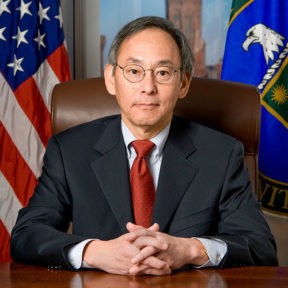
Steven Chu
: Photo from Wikimedia Commons / Author of Photo: Department of EnergyOverview
* Believes that manmade global warming poses an existential threat to the natural environment and all forms of earthly life
* Supports policies — such as “cap-and-trade” — that would discourage carbon emissions by imposing a tax on them
* Said in 2008: “Somehow we have to figure out how to boost the price of gasoline to the levels in Europe.”
* Was appointed Secretary of Energy by President Obama in 2009
The son of Chinese academics, Steven Chu was born in St. Louis, Missouri in February 1948 and grew up in Garden City, New York. He earned a bachelor’s degree in mathematics and physics from the University of Rochester in 1970, and a Ph.D. in physics from UC Berkeley six years later. He then continued at Berkeley as a postdoctoral fellow from 1976 until 1978, at which time he joined the technical staff of AT&T Bell Labs.
In the fall of 1983, Chu became the head of Bell Labs’ Quantum Electronics Research Department. There, he and his colleagues made significant advances in learning how to cool atoms to a temperature of nearly absolute zero (minus-273 degrees Celsius) by trapping light with laser beams and manipulating it within a so-called “optical molasses.”
Chu remained at Bell Labs until 1987, when he left to become a professor of physics at Stanford University where he continued his research on trapping and cooling atoms. In 1997 Chu was awarded a Nobel Prize in Physics for his work in that field.
In 2004 Chu left Stanford to become the director of Lawrence Berkeley National Lab, where he focused on creating advanced biofuels, artificial photosynthesis, and solar technologies. He also took a job as a professor of physics and molecular and cellular biology at UC Berkeley.
Contending that anthropogenic global warming poses an existential threat to the natural environment and all forms of earthly life, Chu exhorts industrialized nations worldwide to drastically cut their greenhouse-gas emissions (most notably carbon dioxide, or CO2), which are produced by the burning of fossil fuels. In April 2007, for instance, Chu said that “coal is my worst nightmare” and expressed doubt that adequate “clean coal” technologies could ever be developed. “We have lots of fossil fuel,’’ he elaborated. “That’s really both good and bad news. We won’t run out of energy but there’s enough carbon in the ground to really cook us.’’[1]
In 2009 the newly elected U.S. President, Barack Obama, named Chu as his Secretary of Energy. At the Energy Department, Chu has warned of “the potential risks of climate change” and called for the U.S. to move toward carbon-neutral energy sources. Toward that end, he supports policies (such as “cap-and-trade“) that would discourage carbon emissions by imposing a tax on them. “It’s prudent risk management,” Chu explains. “It’s like saying, ‘Your house will burn down in the next 10 years — 50 percent probability. By the way, do you want fire insurance?’”[2]
Chu was a member of the Copenhagen Climate Council, which heavily promoted the December 2009 “United Nations Climate Summit” in Copenhagen, Denmark – an event whose purpose was to persuade “global decision makers” to agree on “a new climate treaty” that would reduce greenhouse-gas emissions worldwide. Chu supported the Council’s call (outlined in its Manifesto) for “a global emissions trading system” featuring “strict caps on the emissions of greenhouse gases from the developed countries.” Under the terms of this globalized wealth-redistribution plan, any industrialized nation that exceeded its CO2-emission limit would be penalized in the form of a tax which could be used, in turn, to “leverage significant investment into energy infrastructure in developing countries.”
Shortly before the Copenhagen Conference, Chu asserted that the U.S. had a moral obligation to take major steps toward reducing its own CO2 emissions – regardless not only of the onerous economic repercussions that such measures would trigger, but also of the refusal by China and India to commit to CO2-emission reductions.
As one proposed means of reducing U.S. carbon emissions, Chu called for a gradual increase in gasoline taxes over a 15-year period, so as to persuade consumers to purchase more-efficient vehicles and to reside in neighborhoods closer to their workplace. “Somehow we have to figure out how to boost the price of gasoline to the levels in Europe,” Chu said in September 2008.[3]
Chu reiterated this position in late February 2012, in testimony he gave before Congress. At the time, the national average of gas prices was $3.65 per gallon — approximately double what the price had been when President Obama took office in January 2009. When Rep. Alan Nunnelee (R-Miss.) asked Chu whether it was his “overall goal to get our price” of gasoline lower, Chu said, “No, the overall goal is to decrease our dependency on oil, to build and strengthen our economy.”[4]
Secretary Chu said he “absolutely” favored an increased U.S. reliance on nuclear energy, but cautioned that existing methods for storing and disposing of nuclear waste were inadequate from a safety standpoint.[5]
In May 2010, Chu spoke at the Blue Green Alliance‘s annual “Good Jobs, Green Jobs Conference.”
In 2010 as well, Chu asserted that all newly constructed buildings in the U.S. should be topped with white roofs — a proposal predicated on the theory that: (a) white roofs would reflect, rather than absorb the heat of, sunlight, and (b) this in turn would reduce the need for energy to cool American homes and offices, thereby reducing CO2 emissions. Building regulations, said Chu, should thenceforth “insist that all flat roofs [be] painted white,” and that visible tilted roofs be coated with “cool-colored” paints which absorb much less heat than conventional dark surfaces. He then directed all Energy Department offices to install white roofs in all new construction, all roof replacements, and all instances where such an installation would be cost-effective over the projected lifetime of the roof. In a July 19 news release, he urged other federal agencies to follow suit.
On February 1, 2013, Chu announced that he was stepping down from his post as Energy Secretary. In his resignation letter, he wrote: “Ultimately we have a moral responsibility to the most innocent victims of adverse climate change. Those who will suffer the most are the people who are the most innocent: the world’s poorest citizens and those yet to be born.”
After leaving government, Chu rejoined the faculty at Stanford.
Footnotes:
- “Steven Chu: ‘Coal Is My Worst Nightmare’” (Wall Street Journal, 12-11-2008); “Steven Chu Eases up on the Gas Price Pedal” (NY Times, 1-13-2009).
- “Steven Chu’s Stances on Key Energy Issues: A Primer for His Confirmation Hearing” (Grist.org, 1-13-2009).
- “Times Tough for Energy Overhaul” (Wall Street Journal, 12-12-2008).
- “White House Wants to Keep Gas Prices High” (Daily Signal, 2-29-2012); “Chu: DOE Working to Wean U.S. off Oil” (Politico, 2-28-2012).
- “Steven Chu: ‘Coal Is My Worst Nightmare’” (Wall Street Journal, 12-11-2008).
Additional Resources:
Further Reading: “Steven Chu” (NY Times, 12-5-2008; NobelPrize.org, Britannica.com, InfoPlease.com, Keywiki.org, Energy.gov); “Energy Secretary Chu’s White Roof Fetish” (FrontPageMag.com, 9-23-2010); “[Resignation] Letter from Secretary Steven Chu to Energy Department Employees” (2-1-2013).