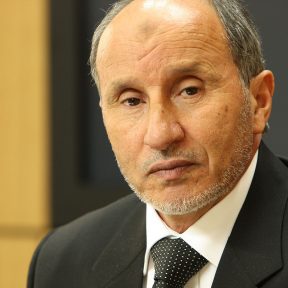
Mustafa Mohammed Abdul Jalil
: Photo from Wikimedia Commons / Author of Photo: Foreign and Commonwealth OfficeOverview
* Longtime Libyan judge/justice minister who opposed the policies of President Muammar Kadhafi
* In 2011 he became chairman of a newly formed National Transitional Council that eventually unseated Kadhafi.
* Seeks to impose Sharia Law on Libya
* Believes that Islamic terrorism stems from the perception that Europe and the U.S. are “against” Muslims
Born in the eastern Libyan city of Bayda in 1952, Mustafa Mohammed Abdul Jalil studied Law and Sharia at the University of Libya. After completing his studies in 1975, he worked as an attorney in the office of Bayda’s public prosecutor before becoming a judge in 1978. In 2002, Jalil was appointed president of Libya’s Court of Appeal. From the start of his professional career in the field of jurisprudence, Jalil was a devoted Islamist guided by a deep commitment to the dominion of strict Sharia law over all aspects of Libyan life. He was considerably more committed to this objective than was Kadhafi.
During his tenure as a judge, Jalil developed a reputation for ruling consistently against the government of Muammar Kadhafi. In an effort to persuade Jalil to adopt a more favorable view of the regime, President Kadhafi’s son, Saif al-Islam, appointed Jalil as Libya’s minister of justice in 2007. That strategy failed, however. In a televised speech to Libya’s General People’s Congress (GPC) in January 2010, Jalil publicly denounced President Kadhafi and declared his intent to resign due to the regime’s “excessive use of violence against unarmed protesters”; its continued detention of some 300 political prisoners despite court rulings that had acquitted them: and its inappropriate release of violent inmates who had been sentenced to death. Kadhafi, in turn, rebuked Jalil for his remarks at the GPC and rejected his resignation, preferring instead to fire him on his own terms and at a time of his own choosing.
In February 2011, Kadhafi dispatched Jalil to the eastern Libyan city of Benghazi to deal with the beginnings of a popular uprising against the regime. After witnessing government forces shooting and detaining peaceful demonstrators, however, Jalil formally resigned his post as justice minister and, within days, became chairman of a newly formed National Transitional Council (NTC) that aimed to unseat Kadhafi and seize the reins of power.
On February 22, 2011, Jalil said he could definitively prove that Kadhafi had personally ordered the 1988 bombing of Pan Am Flight 103, which exploded over the Scottish town of Lockerbie and killed 243 people.
At a February 24 meeting of opposition politicians, former military officers, and tribal leaders in Bayda, Jalil announced that the NTC would conduct no talks with Kadhafi and called for the president to step down immediately. Meanwhile, Kadhafi had placed a $400,000 bounty on Jalil’s head.
In late August 2011, as the NTC was establishing military dominance in Tripoli, Jalil announced that Libya would hold free elections eight months later, and that Kadhafi would be apprehended and tried in Libya instead of being handed over to an international court. “The Kadhafi era is over,” said Jalil, “even if it will only really end with his capture and his conviction for the crimes he has committed.”
On October 23, 2011 – three days after NTC forces had captured and killed President Kadhafi – Jalil declared not only that Sharia law would become the “basic source” of legislation in Libya, but also that any existing laws which were deemed inconsistent with the teachings of Islam would be nullified.
Of particular concern to the United States and its Mideast interests are the contents of a leaked U.S. diplomatic cable from January 2010, in which American ambassador Gene Cretz wrote that Jalil had “noted that many Libyans are still ‘concerned’ about the [U.S. government’s] support for Israel, and that terrorism stems from the perception that Europe and the U.S. are ‘against’ Muslims.”